
String Cheese
Dairy
- Age Suggestion
- 12 months
- Iron-Rich
- No
- Common Allergen
- Yes
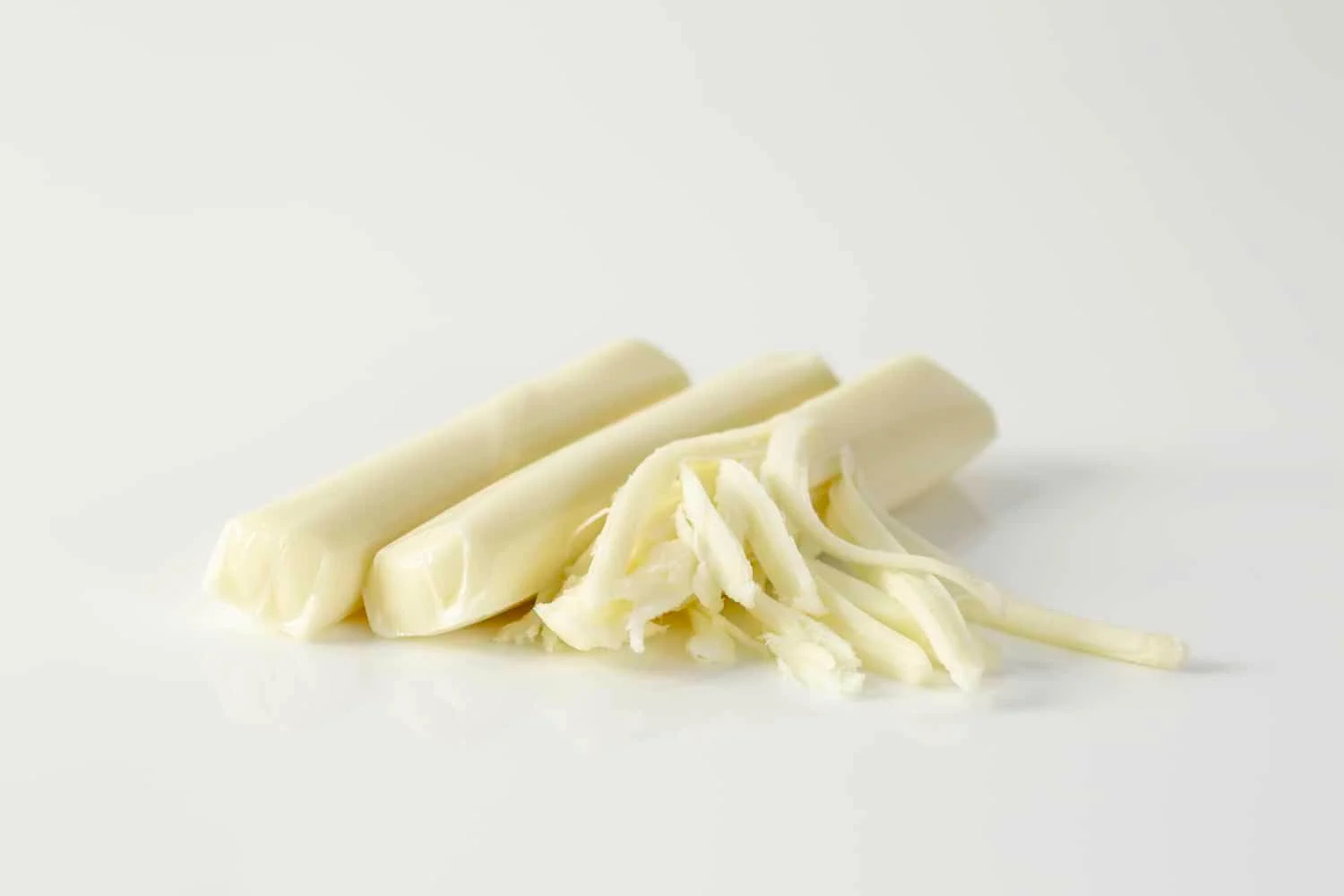
When can babies eat string cheese?
String cheese is best introduced after baby’s first birthday due to an extremely high choking risk posed by its rubbery consistency, slick exterior, and round shape. Make sure to modify the cheese before serving to reduce the risk.
In general, the best cheeses for babies younger than 12 months old are pasteurized and low in sodium, including emmentaler cheese, fresh goat cheese, labneh, mascarpone cheese, fresh mozzarella cheese, paneer, fresh ricotta cheese, and swiss cheese.
How do you introduce string cheese to babies with baby-led weaning?
Every baby develops on their own timeline, and the suggestions on how to cut or prepare particular foods are generalizations for a broad audience.
6 to 12 months old:
Avoid due to high choking risk and high sodium levels.
12 to 36 months old:
Pull the string cheese into thin strands before serving so it is no longer cylindrical in shape to decrease the choking risk. Avoid cutting the string cheese into rounds, as this shape can actually increase the risk of choking. When possible, model pulling the cheese into thin strands in front of the child so they see how to safely eat this food. After pulling the string cheese into thin strands, it is up to you as to whether you want to serve as long strands for biting and tearing practice, or bite-sized pieces cut from pulled strands of cheese to promote the pincer grasp.
36 months and up:
At this age, many toddlers can follow instructions for how to pull string cheese apart themselves, so it’s a good time to actively coach them on this activity. To encourage your child to chew thoroughly before swallowing, model the activity yourself and show your chewing dramatically, with your mouth open to help them visualize and learn how to chew properly. Only serve string cheese when the toddler is seated and supervised. Avoid cutting the string cheese into rounds, as this shape can actually increase the risk of choking.
Is string cheese a common choking hazard for babies?
Yes. Cheese is a common choking hazard, and string cheese poses a higher risk because of its rubbery consistency, slick exterior, and rounded shape. To minimize the risk, pull the cheese into long, thin strings before serving and never cut string cheese into cubes or rounds, which can actually increase the risk. As always, make sure you create a safe eating environment and stay within an arm’s reach of a child during meals. For more information on choking, visit our section on gagging and choking and familiarize yourself with the list of common choking hazards.
Is string cheese a common allergen?
Yes. String cheese is commonly made from cow’s milk, and cow’s milk is a common food allergen in young children, accounting for about one-fifth of all childhood food allergies in the United States.[1] Keep in mind that dairy products from other ruminants such as sheep, goat, and buffalo may provoke similar allergic reactions to cow’s milk dairy products.[2] That said, there’s good news: milk allergy often disappears with time. Research shows that the majority of children with cow's milk allergy will outgrow it by age 6 and many babies with milder symptoms of milk protein allergy (which can show up as painless blood in stool) are able to successfully reintroduce cow's milk as early as their first birthday, with the guidance of their doctors.[3] [4]
Milk is a known trigger of food protein-induced enterocolitis syndrome, also known as FPIES. FPIES is a delayed allergy to food protein which causes the sudden onset of repetitive vomiting and diarrhea to begin a few hours after ingestion. Left untreated, the reaction can result in significant dehydration. Thankfully, like other forms of milk allergy, FPIES which presents early in life is generally outgrown by the time the child has reached 3-5 years of age.[5] While the exact rates of FPIES are unknown, it is believed to be an uncommon condition (although better recognition of the disease has led to increased reporting in recent years).[6]
Although it is not an allergy, lactose intolerance can result in gastrointestinal symptoms such as abdominal pain, bloating, and diarrhea, after ingestion of dairy items containing lactose. For those with older children who are lactose intolerant (keep in mind this is uncommon for infants and toddlers), some good news: compared with milk and certain other dairy products, many cheeses may be better tolerated by those with lactose intolerance, particularly aged cheeses, which have lower lactose content. [7] Note that if your child is lactose-intolerant, it’s important to find calcium-rich foods to consume regularly to ensure a balanced diet and support bone health. Search for naturally low-lactose cheeses and dairy products labeled “lactose-free.”
If you suspect baby may be allergic to milk, consult an allergist before introducing dairy products like cheese. Based on baby’s risk factors and history, your allergist may recommend allergy testing, or may instead advise dairy introduction under medical supervision in the office. If the risk is low, you may be advised to go ahead and introduce dairy in the home setting. As with all common allergens, start by serving a small quantity on its own for the first few servings, and if there is no adverse reaction, gradually increase the quantity over future meals.
Is string cheese safe for babies?
No. String cheese is not safe for babies because of its rubbery consistency and round shape that can block the airway. While string cheese can be pulled apart into thin strands to reduce the choking risk, it is still best to hold off until after baby’s first birthday due to the cheese’s high sodium levels.
Is string cheese healthy for babies?
No. String cheese tends to be high in sodium, which should be limited in infant diets.[8] [9] But for toddlers and older children, depending on the specific product, pre-packaged string cheese can offer great amounts of calcium and good amounts of nutrients such as vitamin B12, zinc, protein, and healthy fats.
For more information on how much cheese babies can eat and other frequently asked questions, see our cheese page.
How is string cheese made?
One of the most popular forms of string cheese is the pre-packaged variety, which is often made of cheddar, colby, or mozzarella. These are produced by heating milk with a coagulant (such as lemon juice or rennet) to form curds, which are strained, pressed, and shaped into tubes or sticks. They may be a lunch box staple today, but the technique of turning milk into stretchy, stringy cheese existed long before the pre-packaged product grew in popularity in the late 20th century. Sometimes the cheese is braided (chechil in Russia), other times it is wrapped into a ball (quesillo in Mexico) or pressed into a round (tenilii from Georgia).
Reference Material
Warren CM, Jhaveri S, Warrier MR, Smith B, Gupta RS. The epidemiology of milk allergy in US children. Ann Allergy Asthma Immunol. 2013;110(5):370-374. doi:10.1016/j.anai.2013.02.016. Retrieved July 23, 2022
El-Agamy, E. (2007). The challenge of cow milk protein allergy. Small Ruminant Research, 68, 64-72. DOI: 10.1016/j.smallrumres.2006.09.016. Retrieved July 23, 2022
North American Society for Pediatric Gastroenterology, Hepatology and Nutrition Foundation. Cow’s milk protein allergy. GI Kids. Retrieved July 23, 2022
Start solids with confidence
- Guided Introduction to 100+ Foods
- Smart Tools to Simplify Mealtime
- Food Allergen 101
- 300+ Meal Ideas
- First Foods® Database

Start solids with confidence
- Guided Introduction to 100+ Foods
- Smart Tools to Simplify Mealtime
- Food Allergen 101
- 300+ Meal Ideas
- First Foods® Database
Expert Tips Delivered to Your Inbox
Sign up for weekly tips, recipes and more.