Readiness to Start Solid Food
How do you know if your baby is ready to start solids? How do you actually get started? And what are the best first foods to give to your baby?
Key Points
Most babies are ready to start solids around 6 months
Most babies are ready to start solids around 6 months of age. Some are ready a little earlier, others a few weeks later.
Signs of readiness are more important than age
Baby is ready when they can sit upright with a little help, hold the head steady, pick up toys and bring them to their mouth while seated, and show interest in your food.
Wait until baby shows all signs of readiness before you begin
Baby needs to show all of the signs to safely start solids. Not ready at 6 months? Wait a week or two. More tummy time will help build strength they need.
Around 6 months of age, most babies are developmentally ready to start solids, but how do you know for sure? Learn the signs from Solid Starts—a multidisciplinary team of pediatric pros helping you raise a happy eater.
When can my baby start eating solid food?
Introduce solids as soon as baby shows all of the signs that they are developmentally ready to practice eating real food.[1] [2] Most full-term babies are ready around 6 months of age, though some are ready a bit earlier and some a few weeks later.[3] For premature babies, look for signs of readiness around 6 months chronological age. Check out Starting Solids with Premature Babies for more guidance.
You may be told to introduce rice cereal and purees around 4 months of age, but this is outdated advice. While recommendations vary from country to country, both the American Academy of Pediatrics and World Health Organization agree that around 6 months of age is the ideal time to introduce solid foods.


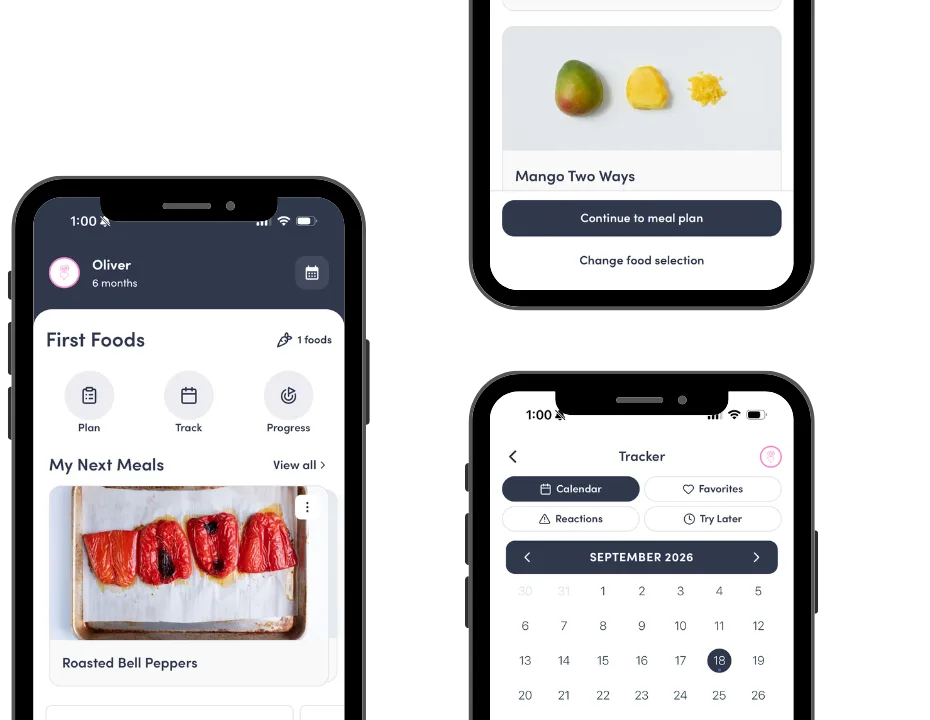
There's even more in the app
Get expert guidance based on your baby's age: serving suggestions, tips, recipes, and more.
Signs Baby is Ready to Start Solids
A baby is ready to start solids when they have reached all of the following developmental milestones:
Readiness Sign | What It Looks Like |
|---|---|
Sitting independently | Baby can sit with minimal support |
Head control | Baby can hold their head upright and steady while seated (about 15 minutes) |
Reach & grab | Baby can pick up toys and bring them to their mouth while seated |
Interest in food | Baby intently watches you eat, mouths of food, or leans forward to reach it |
What does sitting with “minimal support” mean?
Baby can keep the head and neck stable while sitting upright without flopping forward, immediately falling to the side, or hunching back while seated in a high chair or your lap. When baby uses their arms while seated, they don’t topple over. A little support from one arm and hand on the floor is okay, but baby is not ready if they can only sit with both arms and hands planted on a surface for stability. It is normal for a baby who is ready to start solids to need “minimal support” for stability, such as a pillow around their hips, a rolled-up towel in their high chair, or your arm or hands at their hips.
Got questions on high chairs? Check out our Ultimate Guide to High Chairs for Babies.
Is sitting with support okay for babies?
Supported sitting on the floor or in a high chair for a few minutes helps strengthen a baby’s muscles as the child learns to shift weight and correct for loss of balance. This is a widely accepted therapeutic practice for babies with and without delays in their development, and there is no research to suggest that it slows their development or harms their body. Just make sure baby is properly positioned with support from your arm, a pillow, or a rolled-up towel for a little stability. If you are using a sitting "container" like a Bumbo seat, baby swing, bouncy seat, car seat, or stander, consider limiting the time to no more than 30 minutes; regularly placing baby in these sitting containers may slow down the development of muscles and movement.
What if baby is 6 months old but cannot sit up on their own?
If baby cannot sit without a little support from you, wait a week or two to introduce solid food, including purees. At a minimum, baby should to be able to sit completely upright (in a high chair or on your lap) and keep their head upright. If baby needs to be reclined to be stable, they are not ready. Some babies are not ready to start solids until closer to 7 months of age, and that is okay. You can help baby get ready by creating lots of opportunities to build strength with floor time play, such as tummy time and side lying. For more ideas, check out, Best Activities for Preparing for Solids. If baby is not yet sitting with minimal support by 7 months of age, contact your pediatric healthcare provider for support.
Should I wait to start solids until the tongue thrust is gone?
It is not necessary. The tongue thrust is the reflex that causes the child’s tongue to stick out of the mouth when touched. While some suggest waiting to start solids until it disappears, this approach is not supported by research, and it ignores the helpful role that the tongue thrust plays as babies learn to eat real food.[4] To learn more, check out our article, Tongue Thrust & Starting Solids.
Should baby start solids at 4 months for weight gain?
Generally, no. Around 4 months of age, babies are not developmentally ready to eat sufficient amounts of solid foods for weight gain (either purees or finger foods) and breast milk or formula should be their only source of nutrition.[1] Often, introducing solid food at this age can lead to pressure to eat and negative associations with food. Also, many purees are lower in calories than breast milk or formula.
If baby is having difficulty gaining weight before 6 months of age, they are likely not consuming enough breast milk or formula and/or may have an underlying medical condition. Work with a doctor to identify and treat the underlying condition, as well as a pediatric dietitian to carefully increase the caloric content of breast milk or formula, if needed.
Should I introduce allergens at 4 months of age?
There is no need to start solids before your baby is ready unless the child faces a high risk of food allergy due to eczema or an existing food allergy. Emerging evidence suggests exposure to common food allergens such as egg and peanut at this early stage for high risk babies can help reduce the risk of a food allergy from developing.[5] While this may seem counterintuitive since baby is not developmentally ready for solid food, there are developmentally appropriate ways to introduce allergens in puree or liquid forms. Refer to Introducing Allergens for more guidance and consult your pediatrician or pediatric allergist to develop a plan.
When to Seek Help
If baby is around 6 months of age, consult your pediatrician if the child experiences any of the following:
Difficulty holding the head up for short periods of time
Unable to hold body up for short period of time when supported on your lap
Consistent lack of interest in reaching for or grabbing toys
Minimal to no mouthing of toys or hands
Significant changes in weight
Significant decreases in daily wet diapers
Overall lethargy or low energy
General inconsolable irritability
Hard, difficult-to-pass poop
Visible blood in poop
Frequent coughing and/or sputtering at the breast or bottle, especially if paired with frequent upper respiratory infections or unexplained fevers
When so many things fall into the “it’s normal” bucket when it comes to infant development, it’s hard to know when to ask for more help. Your pediatrician is the first step, and sometimes a little reassurance is all you need. They can also help you determine if you need a referral to a pediatric developmental specialist, dietitian, or other pediatric medical specialist.
Frequently Asked Questions
This is one of the most common reasons families start solids early, but research doesn't back it up. Studies show that starting solids does not lead to better sleep, and in some cases, makes sleep worse as baby’s gut adjusts to the new food.. Night waking is normal and healthy in the first year. Many things affect sleep, not just hunger. If baby wakes a lot at night, talk to your pediatrician before rushing into solids.
No. Babies don't need teeth to eat solid foods—they use their gums to mash foods. The back teeth we use for chewing don't come in until after the first birthday. But babies are ready to start learning to eat long before that. Waiting for teeth could mean missing the ideal time to build chewing skills and begin introduction to common food allergens like egg and peanut.
No. The pincer grasp—picking up small pieces with the thumb and one finger—usually starts between 8 and 10 months of age. That's well after most babies are ready to start solids. Younger babies can practice eating by grabbing spoons and scooping food with their hands. This way, they start to develop eating skills while building the hand control they'll need for the pincer grasp later on.
This is often recommended by pediatric authorities to ensure baby is getting enough breastmilk and/or formula to grow and thrive, but it’s not a research backed sign of readiness for solids. What matters is whether baby shows all signs of readiness: sitting with little help, holding their head steady, reaching for objects and bringing them to their mouth while seated, and showing interest in food.
No, not necessarily. Around 3 to 4 months, babies start reaching for and mouthing on everything—your phone, a remote, your spoon, your hair. This is a normal stage of exploring the world, not a sign that baby is ready for food. Interest in food is just one sign of readiness, but they also need to be able to sit with little help, hold their head steady, and bring food to the mouth while seated.
Look for readiness signs around 6 months actual age (counted from their birthday, not their due date). Preemies may take a little longer to show all signs of readiness, and that is okay. Some benefit from a feeding evaluation with a specialist before starting solids. Talk to your pediatrician about what's right for your baby. Learn more about starting solids with preemies.
No. Many families choose to offer both purees and finger foods, and that’s okay. Keep in mind that baby led weaning simply means baby takes the lead and feeds themselves, NOT that they aren’t offered any purees! There's no rule that says you have to pick one method of starting solids. What matters most is that baby is exposed to a variety of textures and flavors from the start and that they are allowed to practice feeding themselves in a calm, pressure-free environment.
Formula can meet a baby’s iron needs, and while breast milk contains some iron, some breastfed babies may need a little extra support from an iron supplement. Talk to your pediatrician for guidance and check out Iron-Rich Foods for Babies for meal ideas.
Very little—and that's expected. Breast milk and formula are the main source of nutrition as babies learn how to eat a variety of foods. Start by offering 1 or 2 pieces of finger food or a small scoop of mashed food, and let them dig in. Exploration, not consumption, is the goal as you get started. With time and lots of practice, they’ll start eating more food at mealtime. Learn more about how to tell if baby is eating enough solids.
No. Spitting out food is normal when starting solids—not a sign that you should stop offering food. Babies are born with feeding reflexes to learn to chew and swallow, and it takes a lot of practice before they get it right. We expect babies to spit out food as they learn, and they may pick up the food and try again. Let them! It’s a sign they’re learning how to eat. Check out more tips for what to do when babies spit out food.
No. The old guidance to wait three to five days between each new food is no longer recommended. You can introduce a variety of foods as soon as you start solids, and there is no need to introduce one food at a time. The exception? Common food allergens like peanut, egg, and dairy. These should be introduced one at a time. This way, if baby has a reaction, you'll know which food caused it. Learn more about introducing common allergens.
Yes, in small amounts in an open cup or straw cup for cup drinking practice. Breast milk or formula should still be their main source of hydration in the first year, so just a few sips of water at mealtimes is plenty. Learn more about water for babies.
If you have the flexibility to wait, there is no reason to rush to introduce solids when your baby is sick. If your baby is often ill with colds and stuffy noses, it may feel impossible to catch them at a time when they are healthy. It's usually fine to offer solids if baby is mildly under the weather, but you may want to wait a few days if they're particularly fussy, congested, or off their usual feeds. Starting solids is a learning process that goes more smoothly when baby is comfortable and engaged. Teething alone isn't a reason to delay—many babies start solids in the middle of teething without issue, and enjoy munching on resistive food teethers! It is recommended to hold off on initial allergen introductions when baby is ill. More on introducing allergens here.
Reference Material
World Health Organization. (2023). WHO Guideline for complementary feeding of infants and young children 6–23 months of age. Geneva: World Health Organization. https://www.ncbi.nlm.nih.gov/books/NBK596427/
Meek, J.Y. & Noble, L. (2022). Section on Breastfeeding; Policy Statement: Breastfeeding and the Use of Human Milk. Pediatrics: Official Journal of the American Academy of Pediatrics, 150 (1)
Wright, C. M., Cameron, K., Tsiaka, M., & Parkinson, K. N. (2011). Is baby-led weaning feasible? When do babies first reach out for and eat finger foods?. Maternal & Child Nutrition, 7(1), 27–33. https://doi.org/10.1111/j.1740-8709.2010.00274.x
Start solids with confidence
- Guided Introduction to 100+ Foods
- Smart Tools to Simplify Mealtime
- Food Allergen 101
- 300+ Meal Ideas
- First Foods® Database

Start solids with confidence
- Guided Introduction to 100+ Foods
- Smart Tools to Simplify Mealtime
- Food Allergen 101
- 300+ Meal Ideas
- First Foods® Database