
Why Messy Eating Is Good for Babies
Published: March 20, 2026
Updated: March 20, 2026
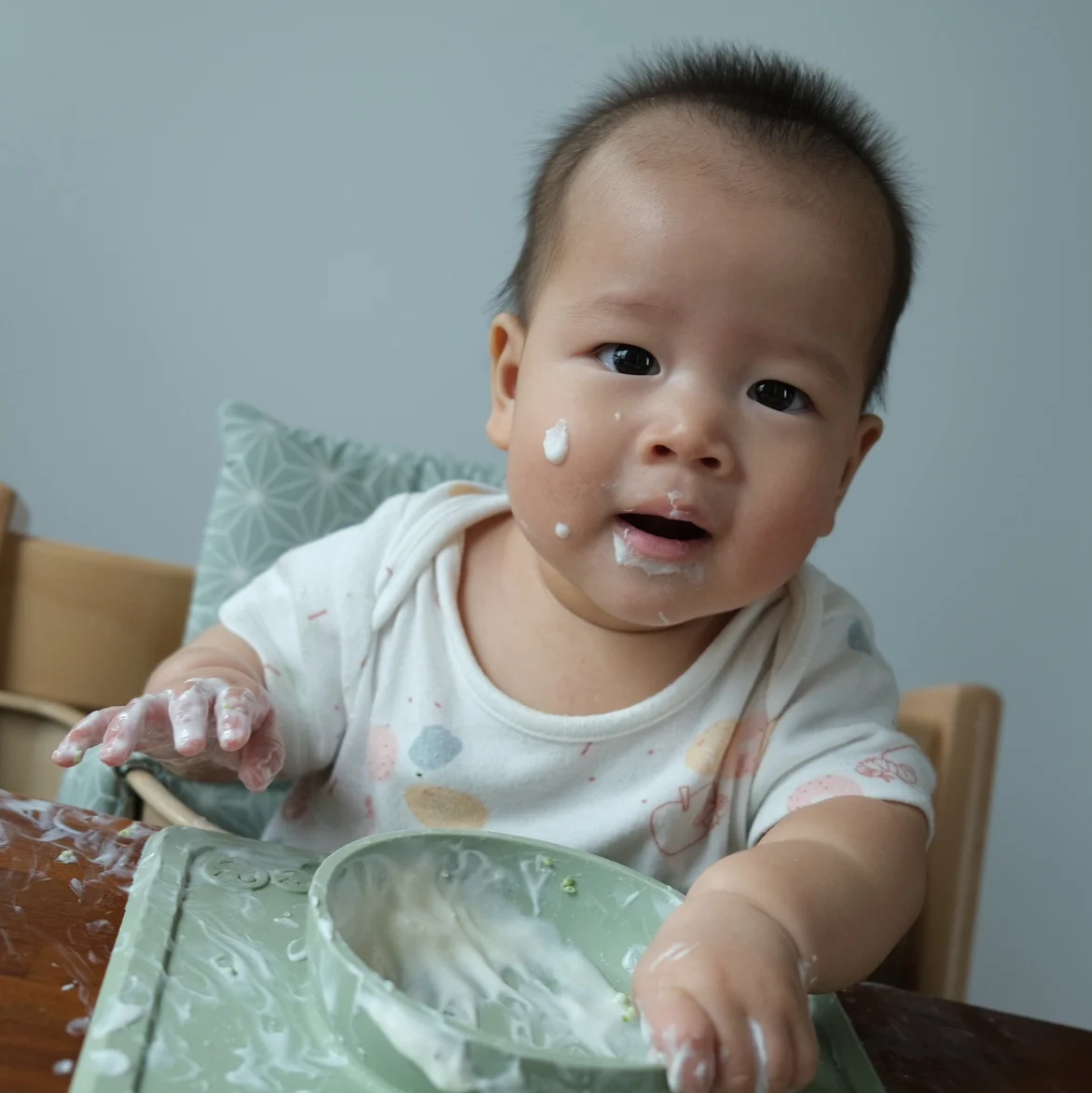
There’s no way around it: babies make a mess as they learn to feed themselves. While the mess can be frustrating for the adults around them, there’s immense value in letting babies dig in. The pediatric pros at Solid Starts explain the developmental benefits of the mess and offer tips for when you just can’t deal with the clean-up.
Need help starting solids? The Solid Starts App can help you navigate first bites and beyond. Get started >
Key Points
✔ Learning to feed yourself involves getting messy
Getting messy at mealtime is important for babies. It’s a sign they’re actively learning, developing their fine and gross motor skills, and practicing their eating skills.
✔ Getting messy can minimize picky eating
When babies dig into their food, they’re learning about different food textures, temperatures, and sensations. This hands-on exploration teaches them that new foods are safe and fun, which greatly reduces the likelihood of strong texture aversions and picky eating later on.
✔ The messy eating phase eventually passes
Babies who are allowed to self-feed when starting solids around 6 months of age usually improve their coordination between 12 and 15 months of age, though mealtimes tend to still be messy through the third birthday.
Why the Mess Actually Matters
Learning to eat and feed yourself is a messy business. There are days when it feels so much easier to just hold the food and feed baby yourself. No splattered yogurt. No slippery avocado on the floor. No full outfit changes. We get it. We’re parents, too.
It’s perfectly fine to pick and choose times for baby to self-feed when you feel capable of handling the clean-up, and choose to spoon-feed at other times when you just can’t deal with the mess.
But here’s the honest truth: the mess has value. And sometimes we all need a little reminder why. Feel free to share this with grandparents or anyone side-eyeing the chaos at your table.
It’s not the mess that’s important. It’s what the mess represents. Mess usually means baby:
Actively participated in the meal
Used their hands to explore
Practiced new motor skills
Took the lead in learning
This level of exploration results in powerful learning. Babies are naturally curious with inherent motivation to explore. To learn to feed themselves, babies need to be allowed to use their hands and practice bringing food to their mouth and taking bites. Like any new skill, this takes time to learn and lots of trial and error is part of the process.
One of the quickest ways to scramble their learning is to insert too much control at the table—control of their hands, control of their spoon, and control over the activity each time baby fumbles. Overriding their desire to learn and explore can be quite challenging to undo. It may lead to months and sometimes years of work trying to return to a place of internal motivation and joy at mealtimes. That’s why we always stress the importance of giving baby space to learn… even when it gets messy and takes more time.
As parents, we know the mess can be incredibly frustrating. While there are ways to minimize the mess, unfortunately there is no perfect mess-free meal to teach your baby to feed themselves. We expect mealtimes to get a little messy when baby is practicing with food, and when the mess triggers big feelings, remember that messy eating is a phase that will pass. Making a mess is learning in action, and eventually, baby will learn to eat neatly like you.
Why Mealtimes Get So Messy
Babies squish, squeeze, and smash food. They drop food on their way to their mouth or wipe it off their tray and onto the floor. They take a bite, spit out food, then put it right back in their mouth. These are all normal and expected behaviors. For babies, getting food from tray → hand → mouth without dropping, smearing, squeezing, or launching it requires building new skills.
Skill Building at Mealtime
Core strength | Keeping the body stable while using hands/arms to reach/grab for food. |
Shoulder stability | Maintaining control of the shoulder while using the arm and hand to reach for and maneuver food. |
Hand control | Using appropriate grip to grab food and amount of force to hold food in the hand. |
Motor planning | Learning the movement pattern needed to reach and grab for the food and bring it to the mouth effectively. |
Sensory processing | Exploring new sensations and receiving information about them to make sense of the experience. |
Oral coordination | Using the lips, tongue, and cheeks to manage the food effectively. |
That’s a lot.
Even after toddlers and older kids develop the ability to eat with more precision, it’s completely normal (and expected) for them to experiment and play with food. Exploration doesn’t stop just because skills improve.
Messy Eating Leads to Acceptance of Foods
Everyone knows a toddler who refuses to eat anything but their favorite foods. While selective eating is a normal phase of a child’s development, it is typically less intense when a child feels safe and comfortable around foods. Building this familiarity starts in infancy when you are introducing solid food. A baby’s curiosity encourages them to investigate by feeling, touching, smelling, and tasting, which gets them comfortable with different:
Textures
Temperatures
Colors
Smells
Wet and dry sensations
By allowing baby to explore food with their hands, you are helping them learn that new foods are safe, fun, and delicious. And when babies can explore food on their own terms, at their own pace, they’re more likely to accept new and varied foods over time. Messy exploration can also help reduce the likelihood of developing strong aversions to texture later on.
Getting Messy Supports Sensory Learning
When babies touch food, they aren’t simply playing with it. They’re learning. Using their hands to feed themselves engages multiple senses at once:
Taste
Touch
Smell
Sight
Sound
It also teaches baby about their body and about food. When baby squeezes a soft piece of food, their brain gathers information:
How hard do I need to bite this? Will it squish or stay firm? How will it feel in my mouth?
This sensory feedback helps the brain create connections. Baby’s brain learns, “When food looks and feels like this in my hands, it will probably feel and move in my mouth like this.”
It also teaches problem-solving skills, “When food feels like this, I will probably need to bite it and chew it like this.”
The more baby explores, the more they hone their oral-motor development by building strength, coordination, and control of the lips, tongue, and jaw. In short, touching food helps babies figure out how food works.
Learning to Self-Feed Involves Getting Messy
Allowing a baby to practice eating is how they learn to feed themselves. For example:
A baby flips a spoon upside down.
The food falls off.
They try again differently next time.
That “experiment” teaches motor planning: having an idea of what to do and organizing and coordinating the body to execute the idea. Being allowed to experiment, use their hands, and take action on their ideas builds confidence and improves their coordination.
Feeding yourself also involves fine motor skills, and babies learn and strengthen these precise, coordinated muscle movements by practicing them over and over again. Mealtimes are a wonderful opportunity for babies to develop these fine-motor skills, which transfer to writing, drawing, dressing, and using tools later on.
Fine Motor Skills Used at Mealtime
Reaching | Extending the arm and hand toward food on the tray |
Grasping | Gripping food with the palm and fingers |
Pinching | Picking up food with the thumb and pointer finger |
Scooping | Using the fingers to gather, lift, and move food |
Stabilizing | Keeping the hand, wrist, and arm steady while bringing food to the mouth |
Holding utensils | Using the thumb and fingers for grip, control, and precision |
Eating isn’t just about hands. It also requires gross motor skills that use muscles in the arms, legs, and torso to sit upright while feeding at the table. Self-feeding at mealtime strengthens these muscles, which are also needed for crawling, climbing, and other gross motor milestones.
Self-Feeding Supports Learning
Mealtimes are rich learning environments for a baby’s cognitive development, especially when they involve eating together. When babies are allowed to get messy and explore food, they learn:
Food properties | How food looks, feels, smells, sounds, and tastes |
Cause and effect | “If I drop this food, it falls.” |
Attention and focus | Focusing on food and on how food behaves in their hands and mouth |
Persistence | Sticking with the task even when it gets difficult |
Social cues | How to behave at the table and mimic your behavior around food |
Emotional regulation | How to stay calm even when your hands feel sticky or you get some banana in your ear |
Internal cues | How to listen to and trust their internal hunger and satiety cues |
New words | When language is paired to describe the foods baby is seeing and touching or the actions they are performing, baby is more likely to make the connection and learn the meaning of these words |
Keeping Messy Mealtimes Positive
Save the clean-up for the end of the meal and try to avoid the urge to bypass the mess by constantly wiping their face and hands while they’re exploring. When we constantly wipe, control, or take over feeding, babies usually get frustrated, mealtimes become tense, and power struggles are inevitable. Few babies like to have their face wiped, and most flat-out hate it. If baby associates the high chair with getting wiped down, they may start avoiding the high chair altogether. Over time, overzealous cleaning can also result in baby not being able to tolerate the feeling of food on their face and hands.
Positive mealtimes in infancy are linked to less food fussiness, more enjoyment of food, and better nutritional outcomes in toddlerhood and beyond. Babies need opportunities to explore freely and tap into their intrinsic motivation and innate drive to learn. When you accept that the mess is part of learning, mealtimes can feel lighter, more playful, and less pressured. You can always spoon-feed or offer foods to minimize the mess on days when you need a break from the clean-up.
Frequently Asked Questions
What if my baby doesn’t like getting messy?
Some babies jump right in. Others hesitate. If your baby seems cautious:
Go slowly.
Start by pairing messier textures with less messy textures– dipping a food teether in a mash or puree is a great way to start.
Offer small exposures.
Keep quantities offered small so as not to overwhelm baby. A pre-loaded spoon, a small amount in a bowl, or even a dollop on the tray or table.
Model touching food.
Poke, swipe, smear - show your baby how it’s done! Dip your fingers in the food and bring it to your own mouth.
Avoid pressure.
Offer food without any expectations, make it as fun as possible– incorporate sound effects “squish squish!” while engaging with the food.
Temperament differences are normal. Some babies are particularly sensitive to touching wet or messy textures and want food wiped off quickly if their hands or face become messy. If you notice this, try bringing a damp, soft cloth to the table and keeping it near baby at each meal. Show them that they can help you wipe their hands on this cloth whenever they become upset. If you are helping to clean them up, use a soft, damp cloth and warn baby before you start cleaning them. For example, you can say, “I’m wiping your face on the count of three.” Pairing a fun song with this can also help to decrease any discomfort as you wipe their face.
If baby refuses to touch messy textures at all, you can try preloading spoons for baby at first. You can also work on increasing their tolerance of messy and wet textures through playtime away from the table. One of our favorite ways to do this is through outdoor play. Playing in a yard, garden, or park grabbing leaves, putting hands in grass or even dirt or mud (with close supervision, of course), or playing with water and water toys can be a valuable way to get baby more familiar with this type of sensory input.
If baby struggles with many textures both at and away from the table, it’s time to talk to your pediatrician. They may suggest a referral to a pediatric occupational therapist who can provide you with support and help the child get comfortable with a variety of textures.
Is messy eating good for babies?
Yes, messy eating in infancy and early toddlerhood is part of learning to self-feed. Babies are sensory-motor learners, meaning they learn from hands-on experiences. At the table, those hands-on experiences lead to a mess as baby learns how much force to use to pick up, hold onto, then let go of a piece of food. The mess gives baby’s brain the feedback it needs to try again with more and more coordination over time.
Is messy eating a symptom of ADHD?
No. Messy eating for babies and toddlers is not a sign that anything is wrong, it’s simply a reflection of the fact that self-feeding (either with fingers or utensils) is challenging at first. Often the mess decreases as a child gets closer to 4 to 5 years of age, though every child’s fine motor skills will develop differently. If you suspect their fine motor skills or attention are impacting their ability to eat efficiently or without excessive spills, contact your child’s medical provider and discuss a referral to a pediatric occupational therapist in your area.
Why is my baby so messy when eating?
All babies are messy while eating because learning to use their hands and fingers in a coordinated way is challenging. And adding in control over a utensil just increases the challenge. Baby is learning and as they build skill, the mess will slowly improve.
At what age should kids stop being messy eaters?
Typically children become less messy at the table between 4 and 5 years of age, as fine motor skills improve. That said, kids around 5 to 6 years of age are often still quite messy at the table, especially with more challenging-to-control foods like soups, saucy foods, or tacos where it’s easy for the insides to fall out.
How long do babies eat messy?
Hang in there. Babies tend to be quite messy at the table until at least 2 to 3 years old. You should see some gradual improvement in the mess as they get more skilled with using utensils. That said, families that allow baby to self-feed and get messy early, often find the mess beginning to improve around 12 to 15 months.
When should I begin to work on manners with my baby?
Most babies gradually absorb manners by eating with you and mimicking how you behave. In toddlerhood, their language skills are stronger and you can begin lightly coaching them on manners. Just keep in mind that manners are a long game: most children are not able to demonstrate good table manners consistently until closer to 5 years old.
Written By
K. Rappaport, OTR/L, MS, SCFES, IBCLC
K. Grenawitzke, OTD, OTR/L, SCFES, IBCLC, CNT
M. Suarez, MS, OTR/L, SWC, CLEC, PMH-C
Ready to get started?
Download the app to start your journey.
Get 10% Off
Sign up to save and get weekly tips, recipes and more.




Copyright © 2026 • Solid Starts Inc