
Introducing Food Allergens to Baby
Why Doctors Recommend Starting Early
In the United States, food allergies in children rose an astounding 50% from 1997 to 2011 and the prevalence of peanut and tree nut allergies tripled during this time. Interestingly, this is roughly the same period of time in which parents were advised to refrain from introducing peanuts and other allergens until well beyond the first birthday.
That began to change after 2015, when a groundbreaking study demonstrated how the early introduction of peanuts to at-risk babies could reduce the risk of developing peanut allergy by as much as 81%. In other words, delaying peanut introduction could actually increase the likelihood of peanut allergies developing.This landmark study led medical professionals to revise their recommendations around the introduction of peanut and extrapolate the study’s findings to other food allergens like egg, cow’s milk, and wheat. Allergists and other medical professionals now recommend introducing many common food allergens well before a baby’s first birthday.
This shift in guidance may have helped turn the tide. In recent years, food allergies to peanut have dramatically decreased among children in the United States. In 2025, a major study confirmed the link between recommendations for early allergen introduction and a significant decrease in food allergies in babies and toddlers at risk of developing food allergies. Our hope is that food allergies will continue to decline as more families take advantage of the preventative benefits of introducing allergens early and regularly serving them.
Top Allergens for Babies
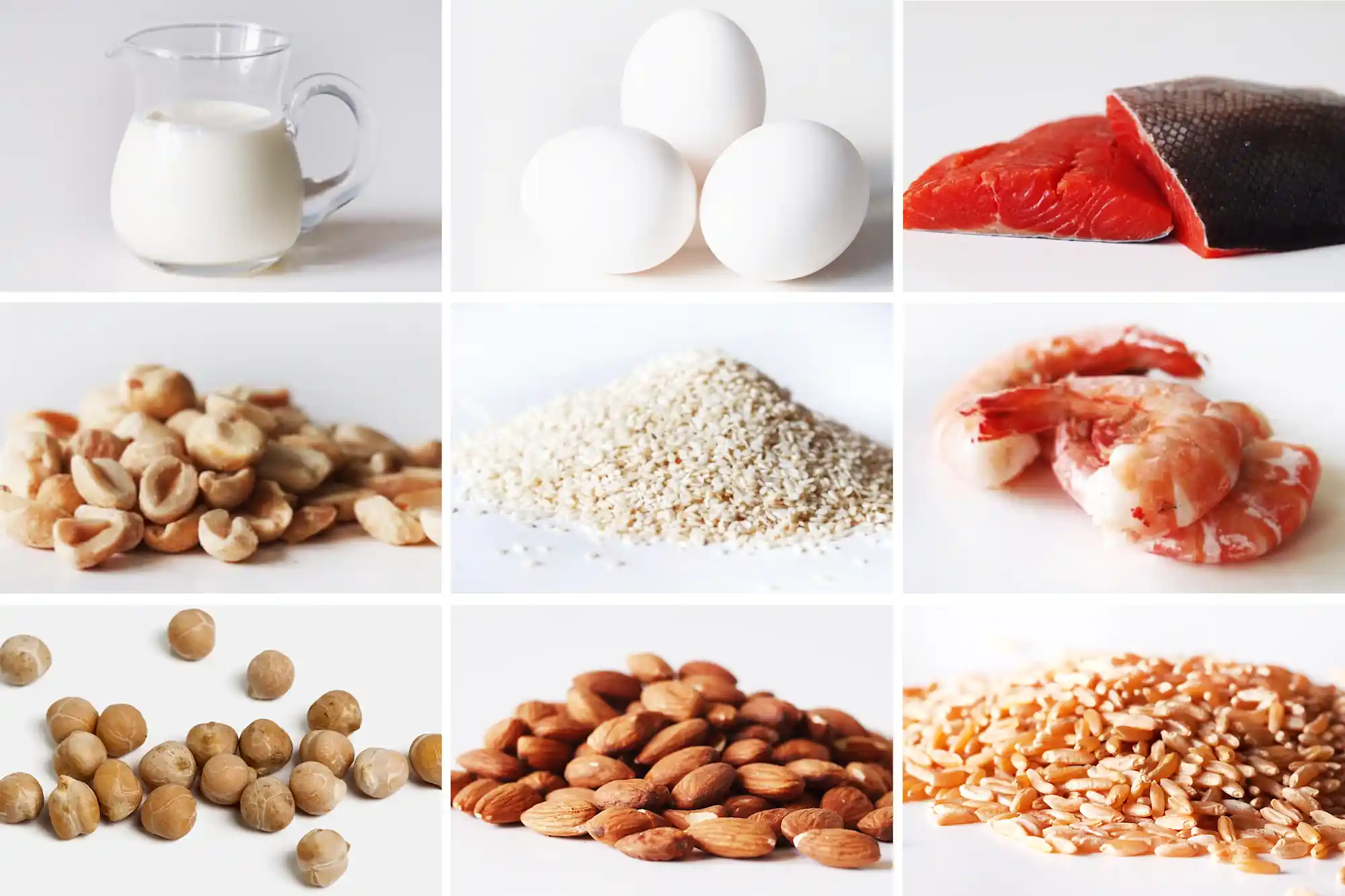
Although it is possible to be allergic to any food, the most common food allergens in the United States are those listed below. Learn more about common food allergens around the world.
Common Allergens for Babies
Allergen | Foods to Introduce Allergen to Baby | Safety Tip |
Cow's Milk | yogurt or soft cheese like ricotta | pasteurized |
Egg | hard-boiled or scrambled egg (yolk and white) | well-cooked, mash into tiny pieces |
Finned Fish | low-mercury fish (cod, salmon, sardines, trout) | fully cooked and flaked (no bones, but skin is okay) |
Peanut | peanut butter | honey-free, smooth texture, thin with water until saucy (no clumps) |
Sesame | tahini or ground-up sesame seeds | if thick, thin with water |
Shellfish (Crustacean) | shrimp, crab, crayfish, or lobster | fully cooked and finely chopped (no shells) |
Soy | tofu or soy yogurt | mash tofu |
Tree Nuts | nut butter or ground nut sprinkle | honey-free, thin with water until loose and saucy |
Wheat | wheat cereal or breadcrumbs | cook cereal with water, use sesame-free breadcrumbs |

How to Assess Baby's Food Allergy Risk
Step 1: Start with their age | Babies around 6 months of age can benefit from allergen introduction within a week or so of starting solids, and for some babies, introduction may be recommended even earlier if they face an increased risk of food allergy. Delaying introduction to allergens can increase the risk of allergies developing, especially if baby has eczema. |
Step 2: Check for eczema | Babies with eczema of any severity are more likely to develop food allergies, but that is not a reason to delay introduction to common food allergens. Babies with eczema can still reap the protective benefits of introducing allergens, and are most likely to benefit from early introduction. |
Step 3: Evaluate allergies | Babies with a known or suspected food allergy to a food are more likely to develop allergies to other foods. For these babies, an allergy evaluation is recommended before introducing other allergens at home (especially if the original reaction was severe). |
Step 4: Take action | The risk of food allergy is high in babies with eczema and/or pre-existing food allergy, so talk to your doctor and make a plan to introduce allergens as soon as possible. If the risk is low, allergen introduction should begin at home as soon as they are ready to start solids (usually ~6 months). |
Babies with eczema and/or a known or suspected food allergy face an increased risk of developing food allergies. For many of these babies, introduction at the early age of 4 months—done safely—can significantly reduce the chance of developing a food allergy. Check out tips for introducing allergens before 6 months of age for guidance.
Signs That Do NOT Increase Risk
These factors alone do not place a baby at a significantly higher risk for food allergy.
Being breastfed vs. formula-fed
Having reflux, colic, or gas
Having a sensitive stomach
Being born prematurely (by itself)
Parent has food sensitivity (not an allergy)
How to Introduce Allergens to Babies At Increased Risk of Food Allergy
Talk to your doctor | Your doctor may recommend introducing peanut, egg, and possibly other common allergens before the child is developmentally ready to start solids. Older babies (7 months of age and up) with severe eczema or an existing allergy to a food may have already developed food allergy, and it is especially important to consult your doctor before you get started. |
Start early | Introduce common foods like peanut and egg earlier rather than later, ideally around 4 months of age. Delaying introduction will NOT prevent food allergies from developing. |
Start small | Allergic reactions can be more severe when more of the allergenic food is consumed. Start with a small amount (such as 1/4 teaspoon) and gradually work up to larger quantities if there are no symptoms of an allergic reaction. |
Is my baby at risk for food allergies?
There are two major risk factors that signal a baby may be at greater risk of developing a food allergy: eczema (especially when severe) and existing food allergy.
How to Introduce Food Allergens to Babies
Introducing food allergens doesn’t have to be scary. You can start with a very small amount of the allergen to minimize any possible reaction and slowly work up to larger servings. For step-by-step guidance, download the Solid Starts App.
1. Assess the risk
Check out How to Assess Food Allergy Risk to determine the risk. If the risk is low, proceed with allergen introduction at home.
2. Be prepared
Review the symptoms of an allergic reaction before you begin. While an allergic reaction is unlikely, it’s best to know what one looks like just in case.
3. Choose a day to start
Pick a day when you are able to closely observe your baby. The introduction can take place over the course of one day (at breakfast, lunch, and dinner, for example) or on consecutive days.
4. Choose a food
Choose one common food allergen to get started. We recommend starting with peanut or egg because the evidence for the protective benefits of early allergen introduction is strongest with these common food allergens.
5. Go one at a time
Complete one allergen introduction before beginning the introduction of another. This way, if there is a reaction, you’ll know which food was responsible.
6. Prepare the food
Start with a small quantity (the smaller the quantity of allergen ingested, the less severe an allergic reaction may be) and gradually work up to offering more. Subscribe to the Solid Starts App to get step-by-step guidance for introducing each common food allergen, including quantities, schedules, and more.
7. Start early in the day
Start at breakfast or right after a morning nap. This way, it may be easier to contact your doctor for guidance in the unlikely event of a reaction. Most reactions occur shortly after exposure, which is why it is best to introduce allergens when at least one adult can focus their full attention on baby, ideally for at least two hours and without distraction from other children or activities.
8. Start with a small taste
Scoop a small amount with the tip of a spoon or your finger, then hold it near their face, and wait for a moment to let them observe the food. They may lean in with their mouth and try to taste—let them. If they do not budge, slowly move it a little closer to their face, then pause and give them another opportunity.
If they hesitate, but otherwise seem engaged, you can gently touch the spoon, teether, or finger to their mouth or tongue, but don’t force it. You want baby to associate food with positive experiences, and forcing food into baby’s mouth does not help achieve this goal. If they are not actively engaged, turn their head, or push the spoon, teether, or finger away, they are communicating to you that they want to stop. Take a break or end the meal. You can always start again later.
Once they’ve tried their first taste, offer more tastes until you’ve offered all of the food you’ve prepared, or they are showing signs that they’re done… whichever comes first. It’s okay if they do not consume all of the food you’ve prepared. Just a small taste is enough to get the introduction process started.
9. Watch for signs of an allergic reaction
After baby has a small taste, move on to your next activity while observing baby. Ideally keep baby in just a diaper or periodically check the skin on their stomach, chest, and back for any signs of rash or redness. If baby shows no signs of a reaction after 15 minutes, proceed with your day (but stay alert). Most reactions occur within minutes (but up to 2 hours) after exposure.
If there are no symptoms of an allergic reaction after a couple of hours, offer the allergen again, and repeat the steps above. A baby may not have an allergic reaction the first time they are exposed to the food, so be watchful as you gradually increase the quantity served. The allergen introduction is complete after the third serving.
10. Aim for regular exposure
Once an allergen is introduced, serve it at least once a week, and ideally 2 to 3 times a week until at least 6 years of age. It’s okay if you need to take a break when your baby is sick or you are traveling. The goal is to offer food allergens frequently when possible to help your child reap the full preventative benefits of early allergen introduction.
Food Allergies Around the World
The United Nations and World Health Organization have established the Codex Alimentarius (Codex), a set of international food standards, guidelines, and codes of practice designed to ensure the safety of the global food supply.
The Codex guidelines recommend disclosure of the following food allergens:
Egg
Milk
Fish
Crustaceans
Gluten
Soy
Peanut
Tree nuts
Sulfites (at concentrations 10 mg/kg or more)
These foods comprise the majority of food-induced allergic reactions in most areas of the world. However, common food allergens vary worldwide and are influenced by genetics, the foods most consumed in those regions, and cross-reactivity with airborne allergens, among other factors.
Africa
Several African nations, including Egypt, Malawi, Morocco, and South Africa, have common food allergen lists that mirror that of the U.N./WHO Codex.
Recent research suggests that food allergies may be underdiagnosed across the African continent.
Asia
There is no central regulatory body governing food allergy labeling for the Asian continent, and common food allergens vary in different areas.
Common food allergen lists for China, Hong Kong, Singapore, Thailand, and Vietnam are similar to the U.N./WHO Codex.
Common food allergens in Japan and South Korea include allergens outlined in the UN/WHO Codex, as well as buckwheat.
Additionally, South Korea lists chicken, beef, pork, pine nuts, peach, and tomato as common food allergens.
While chickpeas are not designated as a common allergen requiring labeling, chickpea is a significant emerging food allergen in India.
Central America, South America & Caribbean States
CARICOM (an organization of Caribbean states), the Central American Technical Regulation countries, Brazil, Venezuela, Argentina, and Chile recognize the same common allergens as outlined by the UN/WHO Codex.
Europe
The European Union (EU), UK, and EEA (Iceland, Liechtenstein, Norway) recognize 14 common food allergens/intolerances—gluten-containing cereals, egg, milk, soy, peanut, tree nuts, fish, crustaceans, mollusks, celery, mustard, sesame, lupin, and sulfites.
Non-EU countries in the region also follow similar guidelines, with minor variations from country to country.
North America
In the United States, there are currently nine foods required for labeling as major food allergens—milk, eggs, peanuts, tree nuts, fish, sesame, shellfish, soy, and wheat.
Mexico and Canada recognize and require the labeling of allergens as outlined by the UN/WHO Codex.
Canada includes mustard and sesame on its list of top allergens.
Southwest Asia
The Gulf States Organization (GSO) recognizes the following allergens—gluten-containing cereals, egg, milk, soy, peanut, tree nuts, fish, crustaceans, mollusks, celery, mustard, sesame, lupin, and sulfites.
Of note, sesame is a very prevalent allergen in this region, and in Israel, studies have identified sesame as the second most common food allergen in children, after milk.
Southwest Pacific
Australia and New Zealand require labeling for common allergens as outlined by the UN/WHO Codex.
Additionally, Australia and New Zealand require labeling for lupin, sesame, bee pollen, and royal jelly.
¿Listo/a para empezar?
Descarga la app para empezar el viaje.
Consejos de expertos directo a tu bandeja de entrada
¡Suscríbete y recibe correos semanales con recetas, consejos y más!




Copyright © 2026 • Solid Starts Inc