If Your Doctor Suggests Starting Solids Early
At a baby’s 4-month well-child visit, your pediatrician may bring up solid food—and they may even suggest that you start introducing purees. Is baby ready? Our pediatric pros offer feeding guidance to keep baby safe, growing, and happy.

At a baby’s 4-month well-child visit, your pediatrician may bring up solid food—and they may even suggest that you start introducing purees. Is baby ready? Our pediatric pros offer feeding guidance to keep baby safe, growing, and happy.
4 months vs. 6 months: when to start solids
You will know baby is ready for solid food when they show that they are developmentally capable.[1] Every child is different, and some babies are ready a week or two earlier than the 6-month mark, while others need a bit more time. Your goal is to watch the readiness signs (not the calendar), and once baby is ready, follow the child’s lead.
While there is not enough research to back up the idea that there are developmental advantages to starting solids before baby is ready, there are benefits when it comes to allergy prevention for babies at high risk of food allergy.[2] For these babies, the early introduction of peanut, egg, and other common food allergens can help prevent allergies from developing later on. Learn more in our article, .
Why some pediatricians recommend starting solids at 4 months
Most families do not need to start solids before baby is developmentally ready, and for most babies this happens around 6 months of age. However, many myths continue to influence individual pediatric practices, and there are still doctors who may suggest for various reasons that you start solids with purees like rice cereal before baby is ready… even though the world’s major medical organizations advise starting when baby is ready “at or around 6 months of age.”[1] [3]
If baby shows none or some (but not all) signs, and your pediatrician is recommending that you get started, here are key questions to ask:
What is my baby doing developmentally that makes you feel they are ready to start solids?
Can you help me understand what the benefit of starting solids at this age would be?
Are you recommending solids for MY baby for a specific reason, or is this a recommendation you make to the majority of your patients?
Try to understand your doctor’s perspective, and make an informed decision based on your conversation and your child’s individual circumstances.
Frequently Asked Questions
It can be as long as baby is showing all of the signs that they are developmentally ready to start solids. If baby shows none or some (but not all) of the readiness signs, it is not safe to offer food that needs to be chewed, but you can try offering purees as long as baby is in a well-supported position and interested in the spoon.
If you choose to offer purees before baby is ready to start solids, make sure to watch how they react to the spoon. If baby is distracted, pushing the spoon away, turning or shaking the head, the child is trying to tell you that they are “done” with the activity. Honor their communication: this not only helps strengthen your relationship with each other, but it helps keep baby safe. Forcing food into a baby’s mouth, even if it is a puree, can increase the risk of choking. Why? The brain is not expecting food to be in the mouth, and it may enter the back of the throat to be swallowed before the body is ready.
Pediatricians often recommend purees because “this is how it’s always been done,” despite a lack of evidence of benefits or utility. When you examine the history of baby food, you find that baby food was a successful commercial product marketed to pediatricians prior to research emerging in infant feeding and how babies learn to chew and eat real food. Research suggests it can take 15+ years for new advances in medical knowledge to make their way into general practice.
No. Breast milk and formula provide all of the nutrition a baby needs during the first 6 months of life, and the world’s major medical organizations recommend exclusively feeding breast milk or formula during this time. Even after 6 months, breast milk and formula continue to be the main source of nutrition until baby has the skills to eat a variety of food to fill the belly—and these skills take months of practice to develop.
Breast milk and formula are best for weight gain in young babies. Starting solids is not an ideal way to help with weight gain because it is not as calorically dense as breast milk and formula, and young babies do not have the skills to consume large volumes of solid food even if it is pureed. In addition, purees (especially pre-made infant purees) tend to be low in calories and key nutrients that babies need like fat, iron, and protein.
Slow weight gain before 6 months of age tends to be the result of baby not consuming enough breast milk or formula, or the body not absorbing the nutrients. You can ask your pediatrician about fortifying breast milk or concentrating infant formula, but do not attempt to do this on your own without ongoing medical supervision. A pediatric occupational therapist or speech-language pathologist, and/or certified lactation consultant can assist with assessing milk transfer and oral motor and swallowing skills that may be impacting your baby’s ability to take in adequate amounts of milk.
You can, but it is not necessary. There are no developmental or nutritional benefits to offering rice cereal to baby whether they are ready to start solids or not quite there yet. Rice cereal is often recommended as a first food because it is fortified with iron, bland, and similar in consistency to breast milk or formula. As formulas have become much more nutritionally complete, and the pediatric medical community better understands the nutritional needs of breastfed babies, this is not necessary for most babies. Additionally, while not supported by evidence, it was once believed that baby could not tolerate anything but bland flavors. Learn more about Rice in our free First Foods® database.
If baby is showing signs that they are hungry, offer more breast milk or formula. Signs of hunger include turning the head toward the breast or bottle, sucking on fists, puckering or smacking the lips, and clenching the hands. If you see these signs, baby is trying to tell you that they want to keep drinking. Breast milk and formula are calorically and nutritionally dense, and baby has all the skills to take in large quantities to support their growth and development.
Generally, no. The research does not show a measurable improvement in sleep patterns after solid food is introduced, yet this persistent myth continues to be passed down from one generation to the next. A baby who consumes more during the day (breast milk, formula, or solid food) may be less likely to want to eat overnight, but night wakings do not stop or decrease when babies start solids. On the contrary, starting solids can lead to tummy troubles like gas, constipation, and frequent stooling, which can cause discomfort during sleep for some babies, and increase the need for soothing overnight.
Some pediatricians may suggest starting solids around 4 months of age to help with infant reflux, yet there is not enough research to support this practice. If reflux is causing discomfort, there are other ways to relieve symptoms. See our article, Starting Solids & Infant Reflux for more information.
Reference Material
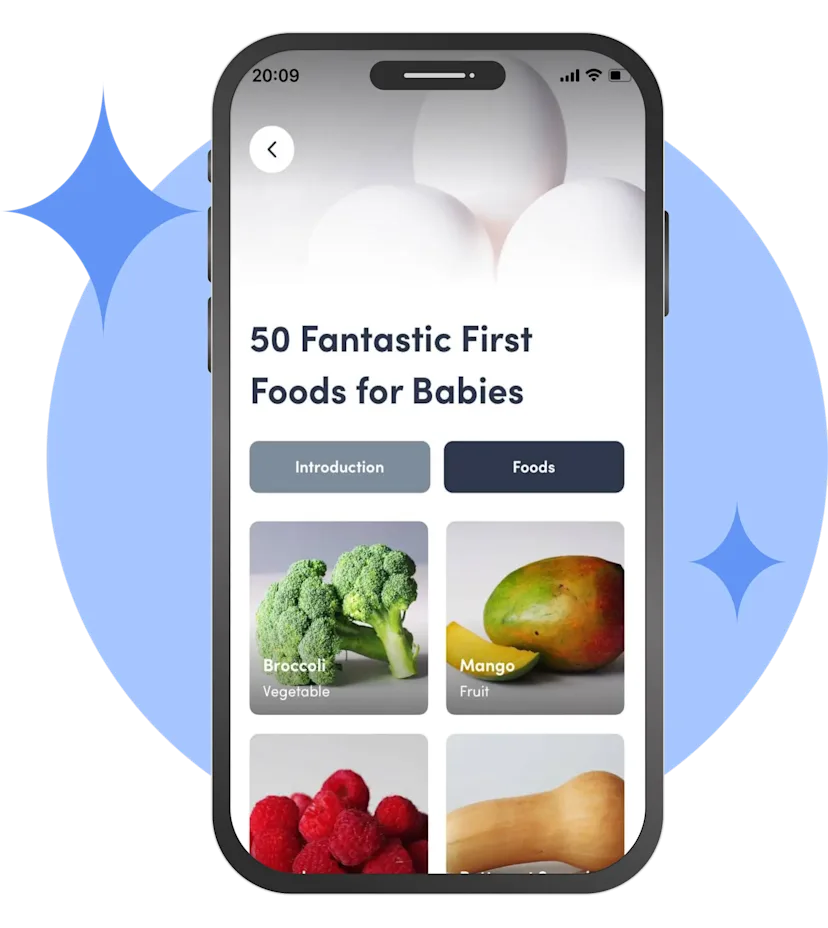
Start solids with confidence
- Guided Introduction to 100+ Foods
- Smart Tools to Simplify Mealtime
- Food Allergen 101
- 300+ Meal Ideas
- First Foods® Database
Start solids with confidence
- Guided Introduction to 100+ Foods
- Smart Tools to Simplify Mealtime
- Food Allergen 101
- 300+ Meal Ideas
- First Foods® Database