
Shallot
Vegetable
- Age Suggestion
- 6 months
- Iron-Rich
- No
- Common Allergen
- No
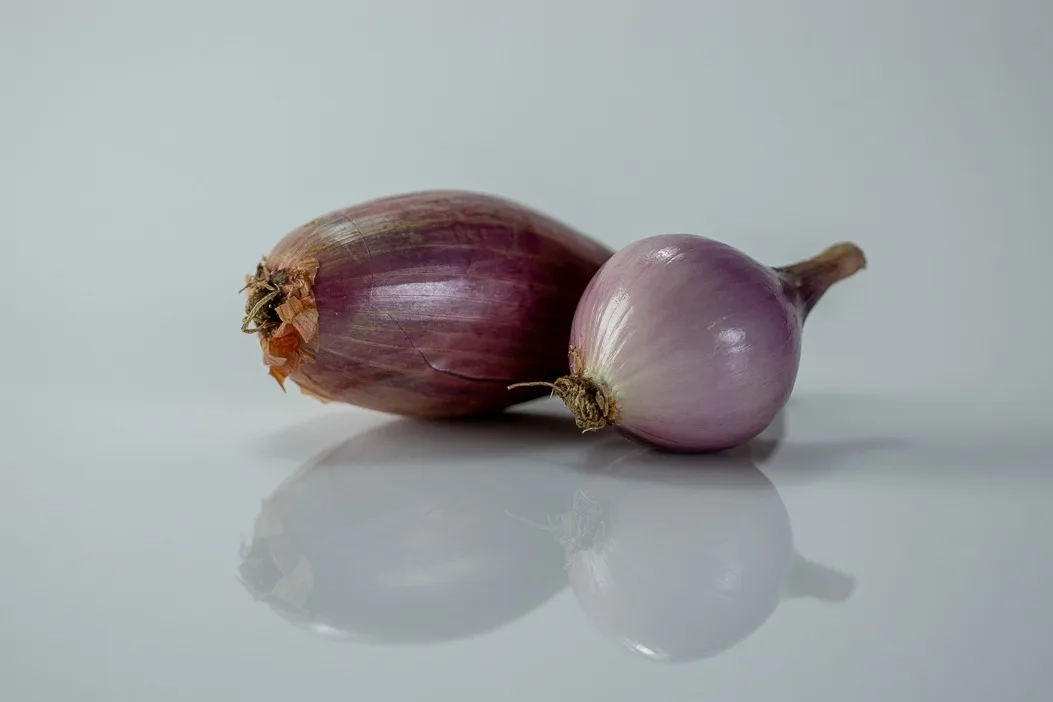
When can babies have shallots?
Shallots may be introduced as soon as baby is ready to start solids, which is generally around 6 months of age.
A relative of the onion, shallots have been used in cooking for hundreds of years. Their precise origins are unknown, but likely somewhere in Central Asia. Like garlic and other bunching onions, shallots grow multiple bulbs or cloves under the ground, with long green stalks visible above the soil. Compared to onions, shallots have a slightly sweeter, milder flavor, which makes them ideal for enjoying raw, but they are also commonly used in cooked dishes, as part of sauces, pickled, and more.
How do you serve shallots to babies?
Every baby develops on their own timeline, and the suggestions on how to cut or prepare particular foods are generalizations for a broad audience.
6 months old +:
Mix well-cooked minced, chopped, or sliced shallots into scoopable foods, such as casseroles, grains, legumes, stews, or rice; or finger foods like frittatas, omelets, bean burgers, or meatballs. Pickled shallots are also fine to share at this age as long as they are fully softened and finely chopped.
9 months old +:
Offer cooked shallot in small chopped pieces or soft, thin slices. Serve on their own or mixed into shared family meals, like soups, stews, frittatas, or meatballs. Pickled shallots are also fine to share at this age as long as they are fully softened and chopped or sliced.
12 months old +:
At this stage of development, larger pieces of well-cooked shallot can help children build chewing and swallowing skills. You can also try serving raw shallot, finely chopped or in thin slices. Alternatively, continue serving cooked chopped shallot as desired.
24 months old +:
When a child has some molars and you feel confident in their ability to thoroughly chew food and not overstuff their mouth, you can serve fried shallots as long as they are not too sharp or firm. When introducing fried shallots, consider starting with just a few as the child practices the challenging texture, either served on their own or as a topping on the child’s meal.
Are shallots a choking hazard for babies?
Yes. Raw shallot can be firm and slippery, which are qualities that pose an increased risk of choking. To reduce the risk, prepare and serve shallots in an age-appropriate way as described in the How to Serve section. As always, create a safe eating environment and stay within reach of baby during meals.
Learn the signs of choking and more about choking first aid in our free guides, Infant Rescue and Toddler Rescue.
Are shallots a common allergen?
No. Allergic reactions to shallots are rare, but allergies to other members of the onion family have been reported on occasion.[1] [2] [3] [4]People who are sensitive to garlic or onions may also be sensitive to shallots, as they are members of the same family of plants.[5]
Raw shallots release a compound called thiopropanal sulfoxide when cut. Although it is not an allergen, this compound can still cause irritation of the eyes, airways, and skin. Cooking shallots can help to break down the thiopropanal sulfoxide and reduce any potential irritation.
Are shallots healthy for babies?
Reference Material
Kobayashi, T., Ito, T., Egusa, C., Maeda, T., Numata, T., Okubo, Y., & Tsuboi, R. (2015). A case of contact urticaria inducing anaphylaxis due to Liliaceae vegetables in a hand eczema patient. Allergology International 64, 211-213.
Moneret-Vautrin, D. A., Morisset, M., Lemerdy, P., Croizier, A., & Kanny, G. (2002). Food allergy and IgE sensitization caused by spices: CICBAA data (based on 589 cases of food allergy). Allergie et immunologie, 34(4), 135–140.
Armentia A, Martín-Armentia S, Pineda F, Martín-Armentia B, Castro M, Fernández S, et al. (2020). Allergic hypersensitivity to garlic and onion in children and adults. Allergol Immunopathol (Madr). 48(3):232-6.
Start solids with confidence
- Guided Introduction to 100+ Foods
- Smart Tools to Simplify Mealtime
- Food Allergen 101
- 300+ Meal Ideas
- First Foods® Database
Start solids with confidence
- Guided Introduction to 100+ Foods
- Smart Tools to Simplify Mealtime
- Food Allergen 101
- 300+ Meal Ideas
- First Foods® Database
Expert Tips Delivered to Your Inbox
Sign up for weekly tips, recipes and more.