
Pork Shoulder
Meat
- Age Suggestion
- 6 months
- Iron-Rich
- Yes
- Common Allergen
- No
When can babies have pork shoulder?
Pork shoulder, when well-cooked, may be introduced as soon as baby is ready to start solids, which is generally around 6 months of age.
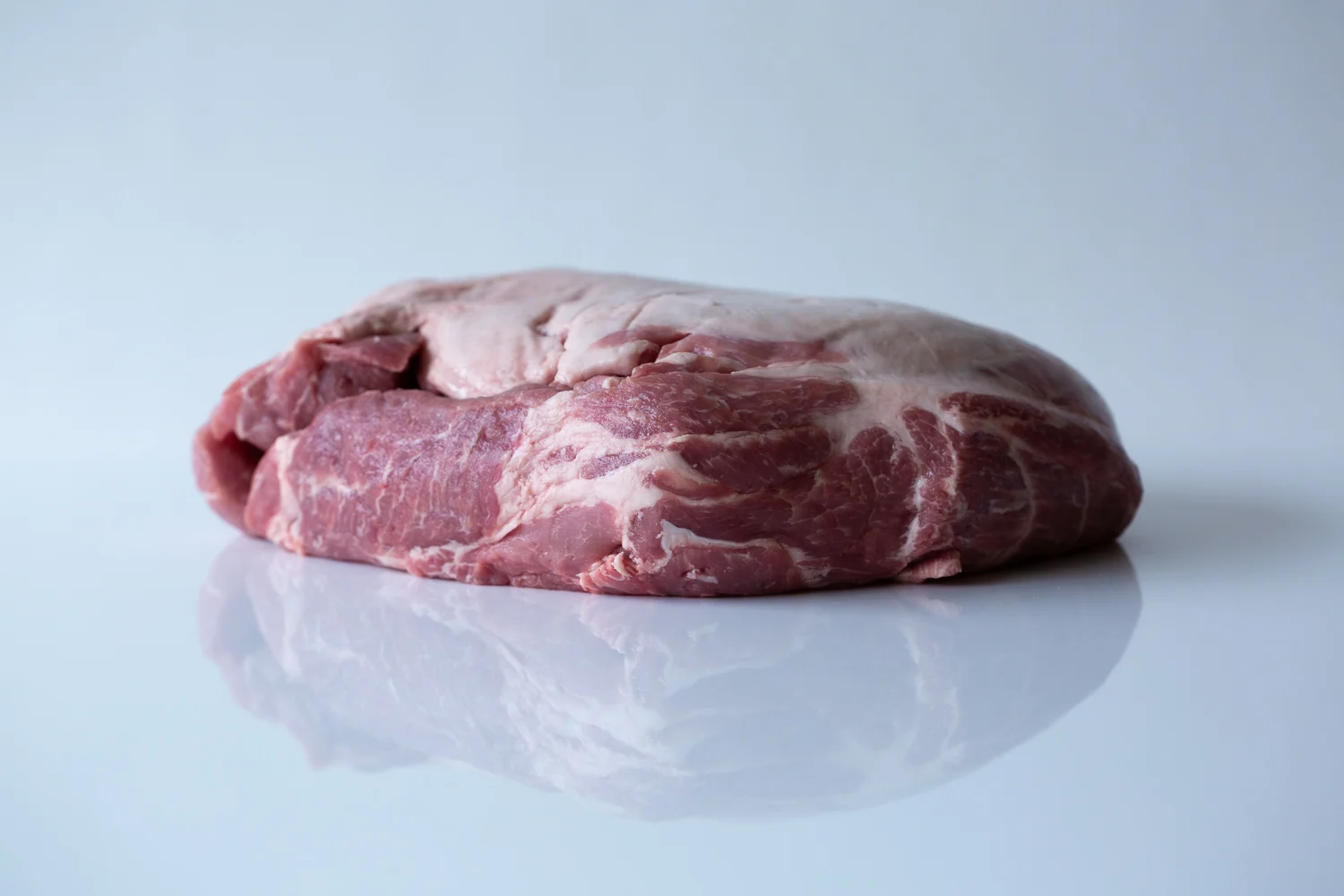
Pork shoulder, also sometimes called picnic shoulder or picnic roast, comes from the lower part of the front legs of the pig. It has been used in cuisines around the world for centuries, from slow-roasted pork in Latin American pernil to braised Chinese red-cooked pork and American barbecued pulled pork. Its rich flavor and versatility make it a popular cut across cultures.
How do you serve pork shoulder to babies?
Every baby develops on their own timeline, and the suggestions on how to cut or prepare particular foods are generalizations for a broad audience.
6 months old +:
Serve strips of tender, well-cooked pork shoulder about the size of two adult fingers pressed together for baby to suck and munch on. Cooked pork can be quite resistive, and baby may not swallow much, which is completely fine. If baby succeeds in biting off a big piece of meat, take a deep breath and give the child the opportunity to work with the food independently. Coaching baby to spit out big pieces of food by sticking out your own tongue can be helpful, too. You can also serve pork shoulder that has been finely chopped or shredded into thin strands, then mixed into a soft, scoopable food.
9 months old +:
Offer pork shoulder shredded into thin strands, either on their own or mixed into other foods, as well as bite-sized shreds of pork for baby to pick up with their developing pincer grasp (where the thumb and pointer finger meet). You can also continue to offer larger pieces of tender, well-cooked pork shoulder the size of two adult fingers pressed together for baby to practice biting and tearing.
12 months old +:
Offer bite-sized shreds of pork shoulder as finger food or let the toddler practice with a utensil. You can also serve pulled pork as desired, on its own or mixed into soups and scoopable foods. To reduce the risk of choking, refrain from offering large chunks of pork or perfectly sized cubes.
Is pork shoulder a choking hazard for babies?
Yes. Pork can be firm and challenging to chew, which are qualities that increase the risk of choking. To reduce the risk, refrain from cutting pork into chunks or cubes and prepare and serve it in an age-appropriate way as described in the How to Serve section. Also, be sure not to overcook pork as this causes it to be dry and more challenging to chew and move backwards to swallow. As always, create a safe eating environment and stay within reach of baby during meals.
Learn the signs of choking and more about choking first aid in our free guides, Infant Rescue and Toddler Rescue.
Is pork a common allergen?
No. Pork is not a common food allergen, although reactions to pork have been reported.[1] [2] Certain tick bites (mainly the Lone Star tick in the continental United States, but other ticks in different parts of the world), are associated with the development of an allergy to galactose-alpha-1, 3-galactose (“alpha gal”), a sugar which is present in all non-primate mammalian meat. This results in a delayed allergic reaction 3-8 hours after red meat, such as pork, is consumed.[3] However, some individuals with alpha gal allergy also react to small amounts of the sugar present in dairy products, gelatin, or organ tissues from mammals. Alpha gal allergy is more prevalent in the southeastern United States but is starting to become more common in other areas as the geographic distribution of the Lone Star tick expands. Although rare, some individuals with cat allergies may also develop a cross-reactive allergy to pork, a condition known as pork-cat syndrome.[2]
Is pork shoulder healthy for babies?
Yes. Pork shoulder offers protein, vitamins B6 and B12, choline, and zinc, as well as some potassium and selenium. Together, these nutrients fuel cell growth, neurodevelopment, and power the endocrine, immune, and nervous systems.
★ Tip: Cook fresh pork to 145 degrees Fahrenheit (63 degrees Celsius) before serving.[4] Undercooked and raw pork poses a high risk of foodborne illness and is associated with trichinosis (a parasite infection), taenesis (a parasite infection), yersiniosis (a bacterial infection), and other diseases.[5] [6] [7]
What’s the best way to cook pork shoulder for babies?
Slow cooking, braising, and pressure cooking all work well to break down the fibers and create a soft texture that’s easier for babies to chew.

Reference Material
American College of Asthma, Allergy, & Immunology. Meat Allergy. Retrieved June 1, 2021.
Wilson, J.M., Platts-Mills, T. (2018). Meat allergy and allergens. Molecular immunology, 100, 107–112. DOI:10.1016/j.molimm.2018.03.018. Retrieved June 1, 2021.
American Academy of Allergy, Asthma, & Immunology. Alpha-gal defined. Retrieved June 1, 2021.
Start solids with confidence
- Guided Introduction to 100+ Foods
- Smart Tools to Simplify Mealtime
- Food Allergen 101
- 300+ Meal Ideas
- First Foods® Database

Start solids with confidence
- Guided Introduction to 100+ Foods
- Smart Tools to Simplify Mealtime
- Food Allergen 101
- 300+ Meal Ideas
- First Foods® Database
Expert Tips Delivered to Your Inbox
Sign up for weekly tips, recipes and more.