


Access our First Foods® Database in the Solid Starts App.
Learn moreHorned Melon (Kiwano)
Fruit
Age Suggestion
18 months
Iron-Rich
No
Common Allergen
No
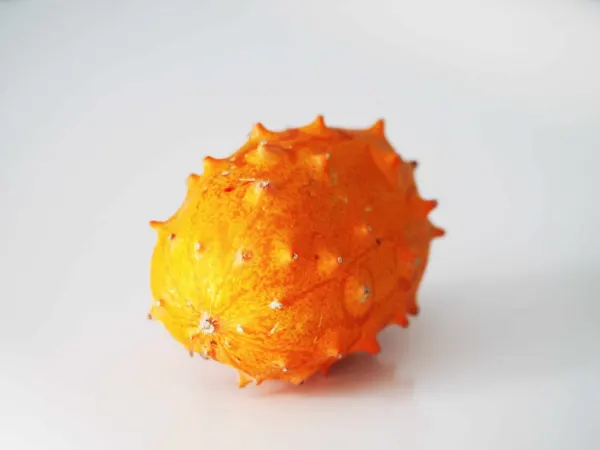
When can babies eat horned melon?
Because horned melon is full of large edible seeds that are impossible to pick out, the fruit is best introduced after your child is 18 months old. Always purchase horned melon from a reputable source as there are ornamental bitter varieties that are toxic to mammals.
How do you prepare horned melon for babies with baby-led weaning?
Every baby develops on their own timeline, and the suggestions on how to cut or prepare particular foods are generalizations for a broad audience.
6 to 18 months old:
If you are keen on introducing this tricky melon at this age, it’s best to just pour the liquid-like interior into a bowl and let your child finger paint with it. If you want to pick out the edible seeds to be extra cautious, you might be able to achieve that with fish tweezers, though be prepared for it to be tedious and time consuming. Either way, the melon’s pulp will be best consumed on top of something else, such as yogurt, ricotta cheese, or even braised meats.
18 to 24 months old:
At this age it can be fun to introduce the whole melon, cut in half, for your toddler to scoop from. Start by washing the spikey rind to rid the flesh of any contaminants that may get inside when you cut it open. Then cut any too-sharp spikes off the melon and then cut the melon at the equator. From here, let your baby scoop out the gelatinous flesh with their fingers or drink from the melon like a cup. Horned melons are also great additions to smoothies. Just scoop out the slimey green interior, seeds and all.
Horned melon has an excellent shelf life and should not be refrigerated as it is a cold-sensitive fruit and will expire more quickly in cold temperatures.
For more information on how to cut food for babies, visit our page on Food Sizes & Shapes.
Videos
Is horned melon a common choking hazard for babies?
It can be, because the edible seeds are impossible to separate from the jelly-like interior. (Many adults who regularly eat horned melon spit out the seeds.) Though the seeds are thin and flat, it is best to hold off on serving horned melon until your baby is 18 months or older or to eliminate the choking risk by pulverizing the seeds and flesh into a smoothie in a powerful blender.
For more information, visit our section on gagging and choking and familiarize yourself with common choking hazards.
Is horned melon a common allergen?
No—horned melon is not on the list of common food allergens. However, individuals with Oral Allergy Syndrome (also referred to as “pollen-food syndrome”) may be sensitive to horned melon.
As with all new foods, introduce by serving a small quantity of horned melon pulp and watch closely as your baby eats. If there is no adverse reaction, gradually increase the quantity over future servings.
Is horned melon healthy for babies?
Yes. Horned melon actually contains a fair amount of protein in the seeds, along with vitamin C, copper, iron, and zinc—all critical nutrients for growing babies. In fact, one horned melon (seeds and pulp) contains a whopping 2.4 mg of iron (22% of your baby’s daily needs) and 100% of your baby’s daily needs for omega-3 fatty acids. Hopefully, your little one won’t eat that much horned melon in one sitting, since the fruit also contains fiber, which inevitably leads to, well, poop.
Background and origins of horned melon
Horned melon is also known as African cucumber, blowfish fruit, English tomato, hedged gourd, kiwano, jelly melon, and spiked melon. While all parts of the fruit are edible—rind, seeds, and pulp—the fruit is mostly sought out for its gelatinous interior, which tastes like a cross between a cucumber and mild kiwi. When ripe, the spiky fruit has a vivid orange skin, and once you cut into it, surprise! The inside is a bright emerald green.
Written and reviewed by these specialists
Expert Tips Delivered to Your Inbox
Sign up for our newsletter for feeding tips, updates, and more.




Copyright © 2026 • Solid Starts Inc