


Access our First Foods® Database in the Solid Starts App.
Learn moreGai Lan (Chinese Broccoli)
Vegetable
Age Suggestion
6 months
Iron-Rich
No
Common Allergen
No
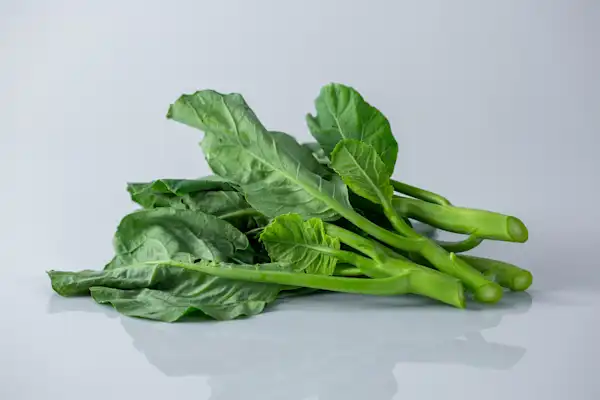
When can babies have gai lan?
Gai lan, also known as Chinese broccoli, Chinese kale, or jiè lán, may be introduced as soon as baby is ready to start solids, which is generally around 6 months of age.
Gai lan has deep roots in East Asian agriculture and cuisine, where it has been cultivated for centuries and remains a staple ingredient across southern China, Hong Kong, and Southeast Asia. Often stir-fried with garlic, braised in oyster sauce, or added to noodle soups, gai lan is valued not only for its flavor but also as a symbol of prosperity and well-being in Chinese food culture. Its popularity led to its spread through trade and migration, making it a familiar vegetable in Vietnamese and Thai cooking as well.
How do you serve gai lan to babies?
Every baby develops on their own timeline, and the suggestions on how to cut or prepare particular foods are generalizations for a broad audience.
6 months old +:
Offer long pieces of cooked gai lan stalk for baby to hold and munch on–the stem makes a natural food teether that helps baby practice chewing skills. If desired, you can further reduce choking risk by cutting the stalk in half lengthwise so that it is no longer round. It’s okay to leave the florets and leafy parts on the stem for baby to explore, but they’ll get floppy when cooked and may be challenging for baby to work with, so it’s fine to cut or tear them off the stem as well. If you have large gai lan stalks with thick skins, peel the skin before cooking, but if the skin is thin and easy to pierce, it’s fine to leave it on. Alternatively, mash or finely chop cooked, soft gai lan and mix into a scoopable food like congee or finger foods like egg strips.
9 months old +:
Serve bite-sized pieces of cooked, soft gai lan, halved lengthwise to reduce choking risk, for baby to pick up with their developing pincer grasp, where the thumb and first finger meet. You can also continue to serve long pieces of cooked gai lan stalk for practice biting and tearing, or finely chop and incorporate into soups, noodle dishes, dumplings, or pancakes. If you have large gai lan stalks with thick skins, peel the skin before cooking, but if the skin is thin and easy to pierce, it’s fine to leave it on.
12 months old +:
This is a great time to work with utensils, pre-loaded with bite-sized pieces of cooked gai lan as needed. As the child develops their tearing and chewing skills, you can decrease the amount of time you are cooking the gai lan a bit, if desired. Follow the child’s ability and serve gai lan how the family enjoys it.
Videos
Is gai lan a choking hazard for babies?
Yes, raw or undercooked gai lan is firm and hard to chew, qualities that increase the risk of choking. To reduce the risk, prepare and serve gai lan in an age-appropriate way as described in the How to Serve section. As always, create a safe eating environment and stay within reach of baby during meals.
Learn the signs of choking and more about choking first aid in our free guides, Infant Rescue and Toddler Rescue.
Is gai lan a common allergen?
No, gai lan is not a common allergen. Gai lan is part of the cruciferous vegetable family, and individuals who are allergic or sensitive to other members of the cruciferous family, such as mustard greens or broccoli, may be sensitive to gai lan as well.
Individuals with Oral Allergy Syndrome (also known as pollen food allergy syndrome), and in particular, those with sensitivities to mugwort pollen, may also be sensitive to cruciferous vegetables, like gai lan. Oral Allergy Syndrome typically results in short-lived itching, tingling, or burning in the mouth and is unlikely to result in a dangerous reaction. Cooking gai lan can help minimize or even eliminate the reaction.
Is gai lan healthy for babies?
Yes. Gai lan is rich in folate and plant-based omega 3 fatty acids (ALA), plus it offers vitamins A, C, and K, as well as calcium, fiber, and lutein and zeaxanthin. These nutrients work to support baby’s nervous system, brain development, vision, immunity, blood clotting, bone health, and much more.
Gai lan is rich in vitamin K, an important nutrient for blood clotting that can interact with certain medications. Check with your doctor if your child is on any medications before offering gai lan regularly.
Is gai lan the same as baby broccoli?
No. Baby broccoli, also known as broccolini, is related to gai lan, but they are not the same plant. In fact, broccolini is a hybrid vegetable developed by crossing gai lan with broccoli.
Our Team
Written by

Dr. Sakina Bajowala
Pediatrician & pediatric allergist/immunologist

Kim Grenawitzke
Pediatric occupational therapist, feeding & swallowing specialist, international board-certified lactation consultant

Venus Kalami
Pediatric registered dietitian & nutritionist
Get 10% Off
Sign up to save and get weekly tips, recipes and more.




Copyright © 2026 • Solid Starts Inc