
Baby Growth Charts
Published: March 19, 2026
Updated: March 19, 2026

Pediatricians use baby growth charts to keep tabs on a child’s growth patterns over time. The pediatric pros at Solid Starts explain how to read your baby growth charts, what’s considered normal, and when to worry.
The Solid Starts App can help you and your baby get ready for starting solids. Get started >
Key Points
✔ Growth charts map patterns over time
Growth charts keep track of a baby’s weight, length, and head circumference at key milestones as they grow. It’s the overall trends that matter, not day-to-day fluctuations.
✔ There are healthy babies at every percentile
Growth charts contain percentiles comparing a baby to others at the same age and sex. A high percentile is not “good” and a low percentile is not “bad.” It simply shows where they stand in the population.
✔ Changes in a baby’s percentile are normal
A sharp increase or a flat or declining curve are warning signs, but small percentile changes are expected over time. As long as baby is growing with themselves as their own benchmark, they’re doing just fine.
What is a baby growth chart?
A growth chart helps pediatricians and parents keep tabs on a baby’s weight, length, and head circumference to make sure they’re growing on track. At most doctor’s visits, your baby’s medical provider will take measurements, and then add these measurements to a growth chart to track patterns and see how baby’s growth changes over time.The word “pattern” is important here. Growth charts are not designed to assess the meaning behind day-to-day fluctuations in weight. It’s the pattern of growth over time that matters and provides clues about what’s normal and what is not normal for your child.
Growth charts are one but not the sole measure of health; they should never be used in isolation to draw conclusions about a child’s overall health. Babies come in different shapes and sizes, and each child grows at their own pace. Sex, genetics, and lots of other factors influence a baby’s growth, and each child is unique.
On a baby’s growth chart, the plotted points can also be compared to the growth patterns of other babies who are the same age and sex. Growth charts are separated by sex because differences in growth patterns appear early in infancy. There are also specialized growth charts for children with specific healthcare needs, such as those born prematurely or with conditions like Down Syndrome.
In the United States, growth chart population data comes from the World Health Organization (WHO) for children under two and the Centers for Disease Control for children two and older. The dataset has evolved significantly since the first charts were released in 1977, when data was based on a limited group of formula-fed, white, middle-class infants from Ohio. Today's charts are much more representative. For example, the WHO charts, released in 2006, used data from breastfed infants across six countries—Brazil, Ghana, India, Norway, Oman, and the United States—who lived in smoke-free homes with access to good healthcare. This makes them a better standard for tracking healthy growth in young typically-developing children.
What Growth Charts Tell You
Growth charts tell you if baby is growing consistently and close to what is expected based on:
how they were growing at their previous appointments
how their growth compares to other babies who are the same age and sex
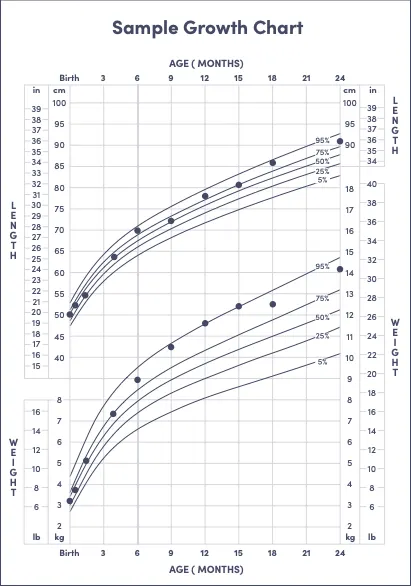
Baby’s personal metrics—weight, length, and head circumference—are plotted as points on the chart. This allows you to compare your baby’s metrics to the percentile curves, determining where they stand amongst their peers of the same age and sex.
At your well-child visit, your pediatrician may say baby is “following the curve” or “falling off the curve” when speaking about their growth. What does that mean?
The “curve” refers to percentiles on a baby’s growth chart. These long upward curves run parallel to one another and represent percentiles between 2 and 98.
Percentiles are frequently misunderstood. For example, on the sample growth chart above, the plotted points show that this baby weighed almost 7.5 kg at 4 months of age, placing them on the curved line representing the 75th percentile. This means that if you placed this baby in a room with 100 babies of the exact same age and sex, they would weigh more than 75 and less than 25 of the other babies in the room.
How to Interpret Baby Growth Chart Percentiles | |
5% weight | Baby weighs more than 5% and less than 95% of other babies of the same age and sex. |
75% length | Baby is taller than 75% and shorter than 25% of other babies of the same age and sex. |
Patterns Over Percentiles
Healthy children can be found at every percentile. A percentile is not a test score or grade: higher is not better, and lower is not worse. There is no prize for reaching the 99th percentile, and no shame in the 5th. There is also no percentile that a child needs to strive for at each age. Pressuring a baby to eat more or less in an attempt to change their percentile can actually disrupt their natural hunger and fullness cues, creating long-lasting stress around food.
Changes in a child’s percentile over time are normal, and their curve usually smooths out over time and rarely indicates a problem. For example, on the sample growth chart above, the plotted points show how the baby’s weight moves between the 75th and 95th percentile curves between 4 and 24 months of age. This movement is neither “good” nor “bad” but simply a visual that shows how they are growing along *their own curve* just beautifully. As long as baby is growing with themselves as their own benchmark, they are doing just fine.
Weight-for-Length Ratio
Growth charts show a baby’s “weight-for-length” ratio that compares their weight with their body length to understand a baby’s body proportions. This ratio offers insight into whether a baby tends to be more slender or more filled out, serving as their own personal benchmark. However, this measurement is only as accurate as the weight and length measurements it relies on—if either is off, the ratio will be skewed.
How to Know If There Is A Problem
Growth charts are not perfect diagnostic tools, but they can offer warning signs. For example, a long-term decrease in weight or length percentiles (a flat or declining line over time) would suggest the baby is not gaining adequate weight or growing at a healthy rate.
It is important to remember that growth charts are helpful tools, but they are not the full picture. First off, getting accurate measurements on infants is genuinely difficult. Weight can fluctuate based on recent feedings, wet diapers, clothing, illness, teething, or growth spurts. It can also vary when different scales are used to measure their weight. Even length measurements can vary depending on how still or squirmy a baby is during their exam.
It’s important to understand that these factors influence weight and length measurements so you can avoid unnecessary stress when comparing a baby’s latest metrics to previous measurements. Additionally, growth charts collect data and help analyze patterns over time, but they cannot capture a baby’s happiness, development, or overall health. When growth trends shift, your healthcare team’s job is to help understand why—and to reassure you when everything is fine. If growth patterns suggest that baby needs more support, trust that your pediatrician will inform you.
You should seek help from your pediatrician if you notice:
Clothing becoming noticeably looser
Chronically decreased appetite or energy
Less interest in playing
Refusing to eat or drink liquids
Sleeping significantly more than usual
Fewer than four wet diapers in 24 hours
If you are concerned about growth, express your concerns to your pediatrician rather than trying to adjust feeding on your own.
Frequently Asked Questions
What factors influence a baby’s growth?
A child's growth pattern is shaped by many factors, including:
Parents' personal growth history and genetics
Access to nutritious foods
Overall medical background
Whether they were breastfed or formula-fed
Birth history, including prematurity
Are growth charts accurate?
Generally, yes—but data may be influenced by different factors from one exam to the next. For example, a wet diaper would skew their weight and wiggling might skew their length. You can always ask your pediatrician for a re-check if you’re concerned about this.
What is the ideal percentile for my child?
There is no “ideal” percentile. Babies thrive across all percentiles. A baby at the 99th percentile isn't “better” than a baby at the 20th percentile—both can be perfectly healthy.
When should I be worried by their growth chart?
If growth patterns suggest that baby needs more support, such as profound drops or spikes or flat over time, trust that your pediatrician will inform you. Small shifts in a baby’s percentile are not a cause for concern.
Written By
R. Ruiz, MD, FAAP, CLC. Board-Certified Pediatric Gastroenterologist
V. Kalami, MNSP, RD, CSP
K. Rappaport, OTR/L, MS, SCFES, IBCLC. Pediatric Feeding & Swallowing Specialist
¿Listo/a para empezar?
Descarga la app para empezar el viaje.
Consejos de expertos directo a tu bandeja de entrada
¡Suscríbete y recibe correos semanales con recetas, consejos y más!




Copyright © 2026 • Solid Starts Inc