
Popcorn
Grain
- Age Suggestion
- 3 years
- Iron-Rich
- No
- Common Allergen
- No
Warning
Popcorn is a common choking and aspiration hazard for children and adults alike. Carefully consider a child’s eating skills and ability to listen to instructions before introducing popcorn. Make sure the child is sitting down in a safe eating environment and is fully engaged in the activity when serving popcorn.
When can babies have popcorn?
It is our strong opinion that popcorn is not safe for babies and that it is best to wait to serve popcorn until a child has strong eating skills and the ability to pace themselves (taking manageable bites, not shoveling food in their mouth, chewing food thoroughly, etc.). For many toddlers, this will be after 24 and likely closer to 36 months of age. Even then, popcorn is high-risk and considered a choking hazard for children under 4 years old by the American Academy of Pediatrics, so read the How to Serve section closely before deciding to introduce popcorn and carefully consider the risks.
Indigenous peoples of the Americas learned to harvest and puff corn kernels thousands of years ago. European colonization and trade introduced popcorn overseas and popularized it across North America, where farmers and settlers adopted Indigenous peoples’ growing and cooking techniques for corn. In the 19th and 20th centuries, American technological innovations caused an explosion in popcorn popularity: street cart vendors sold popcorn on city sidewalks and country fairs, movie theaters offered popcorn as a snack, and the invention of the microwave made it easy to make popcorn at home.
How do you introduce popcorn to kids?
Every baby develops on their own timeline, and the suggestions on how to cut or prepare particular foods are generalizations for a broad audience.
6 to 23 months old:
Avoid due to risk of choking and aspiration.
24 months old +:
At this age, some toddlers may be ready to learn and practice how to eat single pieces of popcorn with close supervision and coaching. Before introducing high-risk foods like popcorn, make sure the child is ready to be coached in a supervised setting: they should be able to stay seated and focused, follow directions, and have had success managing a variety of other foods. Know that this activity is not intended as a regular snack time, but intended to be an active learning session for the child. Eating popcorn while walking around or while distracted (such as when watching television) increases the choking risk. Popcorn is considered a choking hazard for children under 4 years old by the American Academy of Pediatrics, so consider the risk in the context of each individual child and even after the age of 4 years, do not offer partially popped or unpopped kernels.
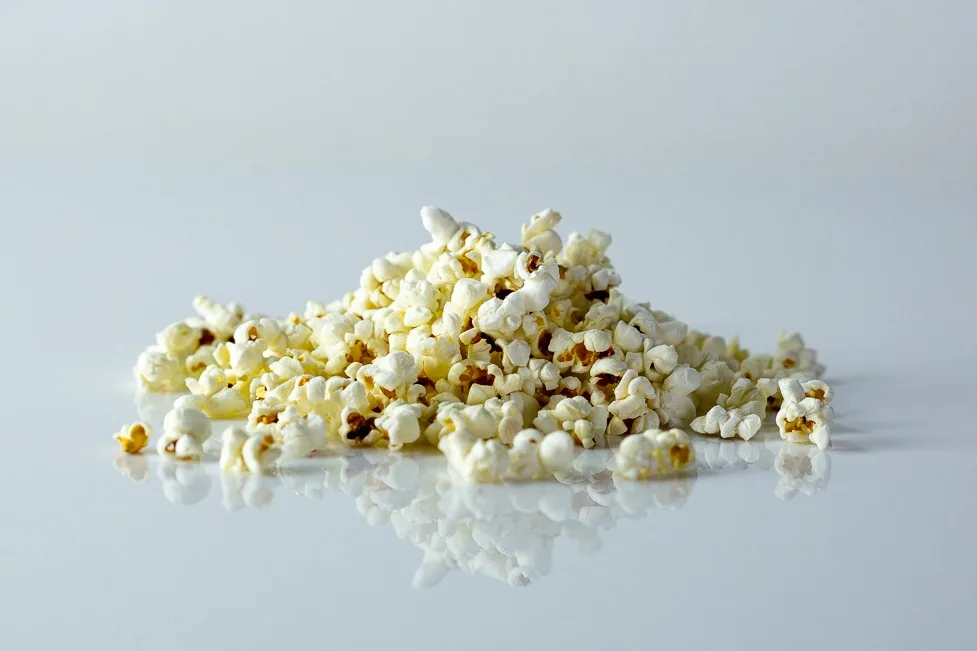
Practice with plain popcorn, as powdery seasonings on popcorn may be inhaled, causing coughing and increasing the chance of an uncoordinated swallow, choking, or aspiration incident. Make sure that all unpopped and partially-popped kernels are removed, pick out and discard any popcorn that is stale, and remove any possible distractions. You may also want to practice eating popcorn immediately following a meal or snack, so that the child isn’t very hungry. There are a couple of additional things you can do to reduce the choking risk early on in teaching a child how to eat popcorn. You can remove the hull (the shiny, translucent piece of the kernel left in the popped popcorn) from each piece of popcorn before offering it to your child. You can also consider offering hull-less popcorn, if it’s available to you. This variety of popcorn is not truly hull-less, but the hull partially disintegrates during popping.
When teaching a toddler how to chew popcorn, demonstrate by taking one piece and exaggerate moving the popcorn to your molars and chewing. Explain, “I am going to use my big strong teeth to chew this.” Teach the child to check for and remove any unpopped or partially popped kernels. Be deliberate and clear about throwing away the kernels, telling the child that you’re throwing them away because we don’t eat them. Then, offer one piece of popcorn to the child at a time; wait for the child to thoroughly chew the piece and swallow it before handing over another.
When it comes to offering a piece of popcorn without any modifications, or as a regular snack, this comes down to you and your comfort level, whether it is before 4 years of age or after. Know that serving popcorn while a child is walking around, distracted, or playing greatly increases the risk of choking, regardless of the child’s age.
3 years old +:
Toddlers at this stage may be ready for popcorn as a regular snack, but first, make sure that the child has mature eating skills: they should be able to stay seated and focused, follow directions, and have had success managing a variety of other foods. Only serve popcorn while the child is seated and focused on the task of eating; eating popcorn while walking around or while distracted (such as when watching television) increases the choking risk. When serving popcorn, make sure that all unpopped and partially-popped kernels are removed, pick out and discard any stale popcorn, and remove any possible distractions.
If you are introducing popcorn for the first time at this age, demonstrate by taking one piece and exaggerate moving the popcorn to your molars and chewing. Explain, “I am going to use my big strong teeth to chew this.” Teach the child to check for and remove any unpopped or partially popped kernels. Be deliberate and clear about throwing away the kernels, telling the child that you’re throwing them away because we don’t eat them. Then, offer one piece of popcorn to the child at a time; wait for the child to thoroughly chew the piece and swallow it before handing over another.
Is popcorn a choking hazard for babies?
Yes. Popcorn is a common choking and aspiration hazard for babies, children, and adults alike. When you decide to introduce popcorn, know that not all popcorn is created equal. An unpopped or partially popped kernel carries more risk of aspiration than a fully popped kernel.[1] [2] [3] Eating popcorn while walking around or while distracted (such as when watching television) increases the choking risk. To reduce the risk when serving popcorn to toddlers, prepare and serve popcorn in an age-appropriate way, as described in the How to Serve section. As always, make sure you create a safe eating environment and stay within an arm’s reach of the child during meals.
Learn the signs of choking and gagging and more about choking first aid in our free guides, Infant Rescue and Toddler Rescue.
Is popcorn a common allergen?
No. Corn allergies are uncommon, but have been reported, with symptoms ranging from short-lived oral allergy symptoms to anaphylaxis.[4] [5] Some individuals with allergy to lipid transfer proteins or chitinase may also have a corn allergy.[6] [7] Corn is known to cross-react with other cereal grains, especially rice, wheat, and barley. However, most individuals with corn allergy can safely consume other cereal grains, and vice versa.[8] Note that many brands of popcorn in the store contain other allergens (such as dairy and soy), so read ingredient lists carefully.
As you would when introducing any new food, start by offering a small quantity for the first few servings. If there is no adverse reaction, gradually increase the quantity over future meals.
Is popcorn healthy for babies?
While popcorn can be a nutritious food, it is not safe for babies due to the high risk of choking and aspiration.
Is popcorn healthy for kids?
Yes, it can be. Popcorn is made from corn, a whole grain that is rich in carbohydrates and fiber. It also offers micronutrients like magnesium, zinc, and B vitamins. Together, these nutrients provide energy for growing children. They also support the digestion, electrolyte balance, immune system, taste perception, and more. Popcorn offers antioxidants like polyphenols that help support the body’s recovery and resilience.[9] While some types of popcorn are high in sugar and/or salt, these are fine to offer in moderation as part of a variety of foods once you feel confident that the child has the skills to eat popcorn safely.
What are popcorn alternatives for toddlers?
If you are looking for a puffed snack, consider those made from ingredients like chickpea, quinoa, or nuts, all of which will offer nutrients that toddlers need. Also, some companies offer a “hull-less” popcorn—because the corn variety used is smaller, the hull partially disintegrates rather than remaining intact in the fully popped kernel.
Reference Material
Morley RE, Ludemann JP, Moxham JP, Kozak FK, Riding KH. (2004). Foreign body aspiration in infants and toddlers: recent trends in British Columbia. J Otolaryngol. 33(1):37-41. doi:10.2310/7070.2004.00310. Retrieved August 1, 2022
Latifi X, Mustafa A, Hysenaj Q. Rigid tracheobronchoscopy in the management of airway foreign bodies: 10 years experience in Kosovo. Int J Pediatr Otorhinolaryngol. 2006;70(12):2055-2059. doi:10.1016/j.ijporl.2006.07.017. Retrieved August 1, 2022
Cataneo AJ, Reibscheid SM, Ruiz Júnior RL, Ferrari GF. (1997). Foreign body in the tracheobronchial tree. Clin Pediatr (Phila). 36(12):701-706. doi:10.1177/000992289703601206
Start solids with confidence
- Guided Introduction to 100+ Foods
- Smart Tools to Simplify Mealtime
- Food Allergen 101
- 300+ Meal Ideas
- First Foods® Database
Start solids with confidence
- Guided Introduction to 100+ Foods
- Smart Tools to Simplify Mealtime
- Food Allergen 101
- 300+ Meal Ideas
- First Foods® Database
Expert Tips Delivered to Your Inbox
Sign up for weekly tips, recipes and more.