Los niños y el miedo a alimentos nuevos
Around 12 to 18 months, many toddlers become wary of new foods, a normal phase called food neophobia. Here's why it happens and how to respond so it passes smoothly.
Puntos clave
Fear of new foods is a normal phase, not a problem
Around 12 to 18 months, many toddlers who once ate almost anything become wary of unfamiliar foods. This is called food neophobia, it's developmentally normal, and it usually fades with time.
Keep offering and don't swap in a "sure thing."
A toddler can't warm up to a food that never appears on their plate. Continue serving new and refused foods without pressure, and resist replacing them with a preferred food, which can tip a normal phase into picky eating.
How you respond matters as much as what you serve
Toddler food refusal isn't personal and rarely means a lasting dislike. Staying calm, eating the food yourself, and keeping mealtimes low-pressure helps the phase pass sooner, while big reactions or short-order cooking tend to stretch it out.
Lo creas o no, es posible que tu bebé pronto tenga miedo de probar la leche con chocolate.
Una de las razones por las que los/las padres/madres se apresuran a introducir una gran cantidad de alimentos antes del primer cumpleaños de el/la bebé, es porque después de los 12 meses de edad, el miedo a los nuevos alimentos se vuelve más fuerte. Si tu bebé no se ha familiarizado con un determinado alimento para entonces, puede ser mucho más difícil convencerlo(a).
¿Necesitas nuevas ideas sobre cómo motivar a tu niño(a) a probar nuevos alimentos? Consulta nuestra guía Aprendiendo a explorar los alimentos para 15 estrategias que puedes implementar desde hoy.
Esto se debe a que, entre los 12 y los 18 meses, mucho(a)s niño(a)s pequeño(a)s pasan de una fase de intenso interés y exploración (¡me pregunto a qué sabe el zapato de papá!) a una nueva fase de neofobia alimentaria (miedo a los alimentos nuevos).
Algunos antropólogos creen que la neofobia alimentaria se incorporó a nuestro ADN por medio de la evolución. Sugieren que la neofobia habría sido una respuesta protectora en la historia de la humanidad, ya que haría que un(a) niño(a) fuera menos propenso(a) a llevarse objetos venenosos a la boca si se alejaba de su cuidador(a).
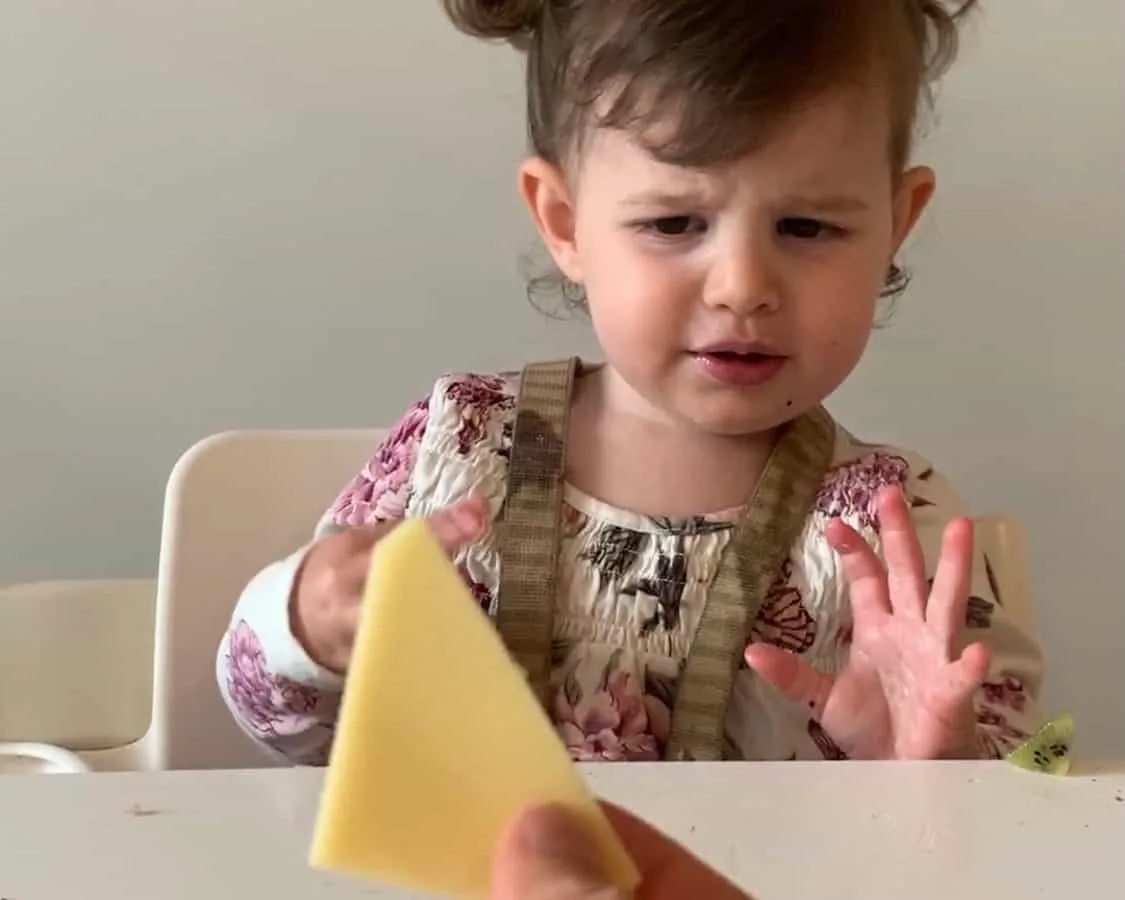
De cualquier manera, puede ser una etapa difícil. ¡Tenías un(a) bebé que comía casi cualquier cosa, y ahora tienes un(a) niño(a) pequeño(a) que es escéptico(a) de todo!
Peor aún, no son solo los alimentos nuevos los que se rechazan durante esta fase. Si tu niño(a) pequeño(a) se da cuenta de que puede rechazar un alimento y obtener algo diferente de ti, puede volverse un juego (en el mejor de los casos) y convertirse en alimentación quisquillosa (en el peor de los casos).
El rechazo de alimentos durante esta etapa no es personal y no significa que a tu niño(a) pequeño(a) no le gusten las comidas que rechaza. Tampoco significa que tu niño(a) pequeño(a) no volverá a disfrutar de nuevos alimentos más adelante. Solo se necesita mucha más paciencia y cuidado en cómo servimos la comida y cómo respondemos al rechazo de la misma.
Algunos consejos:
Ayuda a tu niño(a) pequeño(a) a ver que la comida es segura comiéndola frente a él/ella.
Piensa en la comida como una actividad. Ofrécele a tu hijo(a) un cuchillo entrenador para cortar su propia comida, ten una noche de "arma tu propio taco", etc.
Ofrece comidas nuevas fuera de la mesa, en un lugar libre de presión (en la cocina al preparar la comida, hagan un picnic, etc.).
Emplea el uso de “chispas” (queso rallado, levadura nutricional, semillas de cáñamo, etc.) y salsas.
Por último, continúa sirviendo nuevos alimentos, incluso si crees que tu niño(a) pequeño(a) los rechazará. Tu hijo(a) no puede probar un alimento nuevo si no se lo sirves.
La neofobia alimentaria suele superarse alrededor de los 4 o 5 años. Si has sido constante con ofrecer una amplia variedad de alimentos y no reemplazarlos con otra cosa cuando tu niño(a) pequeño(a) se niega a comer, es probable que pase antes.
El Pase completo de niños pequeños incluye todas las guías y videos que necesitas para sobrellevar los desafíos que se presentan durante la niñez temprana a la hora de comer.
Preguntas frecuentes
We hear this all the time: baby used to eat anything and everything, but right around the first birthday, they start refusing foods, even the ones they used to love. It's not personal and it doesn't mean the food is gone for good. Toddlers are simply in a new developmental phase of life and are driven to say no, test boundaries, and see what happens by trying out different behaviors. Keep serving the food in a low-key and low-pressure way alongside other foods, experiment with different ways of serving the food, resist swapping in a preferred food, and there's a good chance it will cycle back into favor.
Toddlers notice small changes that adults barely register, and in this phase, familiarity feels safe. A banana cut into coins instead of a spear or a new flavor of a familiar granola bar can feel like an entirely new (and therefore untrustworthy) food. This is normal. Toddlers have a better memory than they had as a baby, and they now have expectations, so when a food is served that was different from what they were expecting, this can feel quite frustrating. And because their language is limited and their executive functioning skills are still immature, that frustration can often lead to tantrums and all-out refusals. You can help by keeping some things predictable while varying others a bit over time. Giving the child a heads-up can help so that the change doesn’t feel like a surprise: “Today, we’re having banana circles instead of banana sticks!”
Try not to think of it in terms of giving up. It can take many exposures (often ten to fifteen or more positive or at least neutral experiences with a food!) before a toddler is willing to taste and accept a new food, and some foods take longer. Each time you serve it without pressure, you're making progress, even if it goes untouched. Keep it in the rotation and let repeated, low-key exposure do the work.
No, we don’t recommend it. Here’s the thing: Pressure to take a bite can result in the child tasting the food in the short-term. But in the long-term, it tends to backfire and can make a child more resistant to that food over time. Stick to the division of responsibility: your job is to offer the food and model enjoying it, and your toddler's job is to decide whether to eat it. Letting them come to it on their own terms is more effective than a required bite.
Absolutely. Seeing a food on their plate, touching it, smelling it, squishing it, helping to serve it, or watching you eat it all count as exposures and help build familiarity. Every calm, positive or even neutral encounter chips away at the feeling of "this is new and scary", even when nothing makes it into the toddler’s belly. Tasting is just one part of a longer process of getting comfortable.
For most toddlers, wariness of new foods is a normal phase that resolves with time and patience. But it's worth checking in with your pediatrician if your child's eating is very restricted (if they only have a small handful of accepted foods); if they gag, retch, or vomit at the sight, smell, or texture of many foods; if they're steadily dropping foods without adding new ones back; or if you're concerned about their growth or weight. In these cases, a pediatrician or a feeding therapist can help rule out an underlying feeding or sensory issue and help you come up with a plan.