
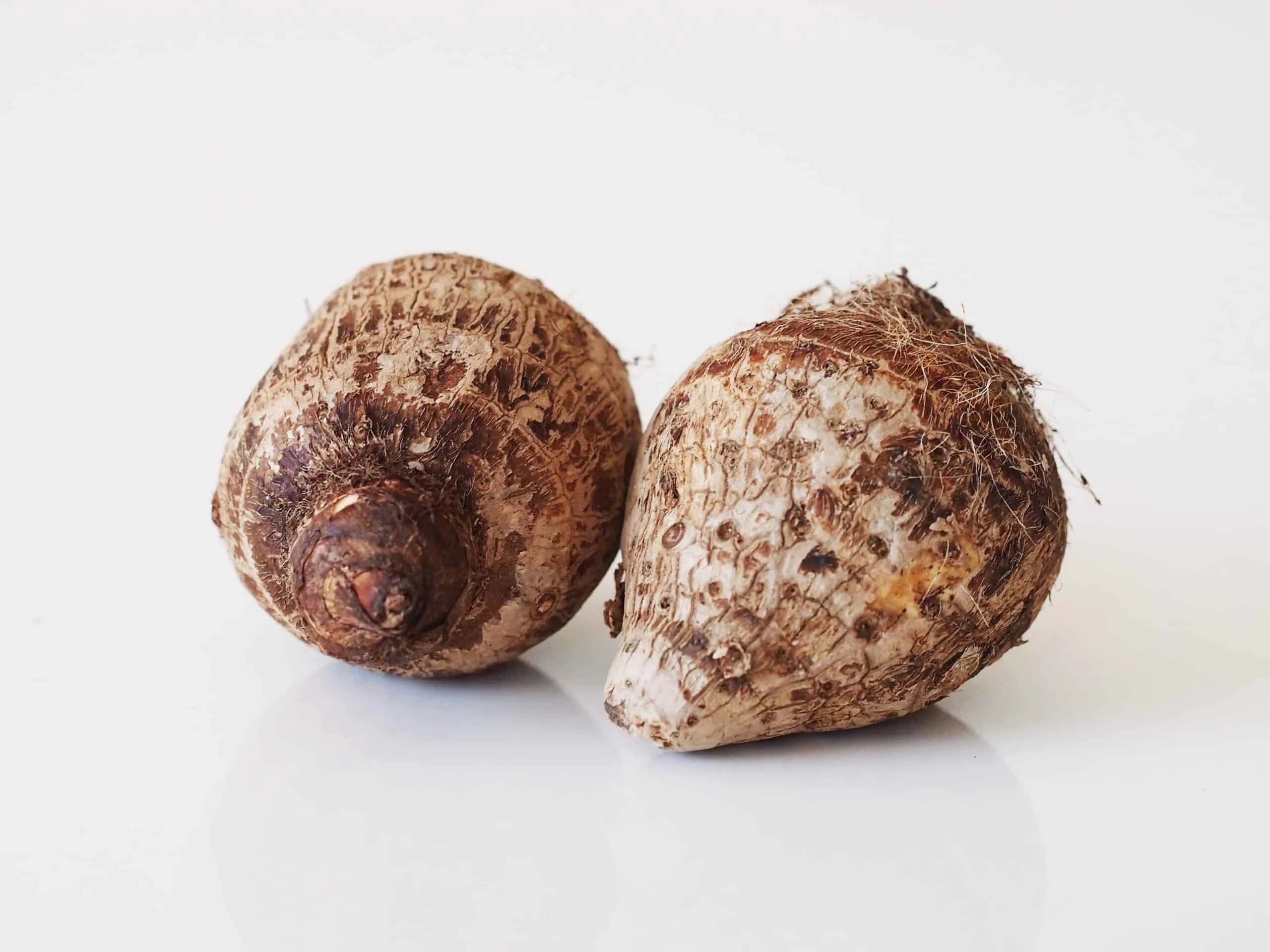
Taro
Verdura
- Edad sugerida
- 6 meses
- Rico en hierro
- No
- Alérgeno común
- No
Warning
When can babies have taro?
¡Lo sentimos, esta página aún no está disponible en español! Estamos trabajando tan rápido como podemos para traducir todo nuestro contenido, gracias por tu paciencia y apoyo.
Cooked taro may be introduced as soon as baby is ready to start solids, which is generally around 6 months of age. The plant’s root and leaves are edible, but all parts must be cooked to reduce the risk of choking and remove toxins. [2]
¿Cómo ofrecer taro a los bebés?
Cada bebé se desarrolla a su propio ritmo, y las sugerencias que ofrecemos sobre cómo cortar o preparar determinados alimentos son generalizaciones para una amplia audiencia.
6 months old +:
Offer peeled, cooked, and mashed taro root and let baby try to self-feed. Fresh (sweet) or fermented (sour) poi may be served at this age. Alternatively, offer cooked, soft taro root cut into wedges about the size of two adult fingers pressed together. Chop cooked taro shoots and leaves to fold into egg dishes, mashed vegetables, grains, and other soft, scoopable foods. Avoid deep-fried taro (chips, fries, puffs, etc.) until after the second birthday to minimize the risk of choking.
9 months old +:
At this age, try serving cooked, soft taro root cut into bite-sized pieces, either on their own or in salads, soups, stews, and stir-fries. Or continue to offer larger wedges of cooked taro for practice with biting. You can also continue to serve poi and mashed taro, as well as finely chopped taro leaves that have been thoroughly cooked. Try offering taro dishes with bolder spices to introduce the child to the idea that foods can have different tastes depending on how they are prepared.
12 months old +:
Continue serving cooked, soft taro in bite-sized pieces, in larger wedges, or mashed, as desired. You can also take this opportunity to encourage utensil practice: offer bite-sized pieces of cooked taro along with a fork for the child to pick up independently. You can also try spearing the sweet potato while making a sound (boink!) to make it fun to use the utensil. Keep in mind that using utensils can be exhausting for new eaters, and many children toggle back and forth between feeding themselves with their fingers and utensils. Try not to apply too much pressure–consistent and accurate utensil use will come in due time–often sometime after the second birthday.
Is taro a choking hazard for babies?
No. Cooked, soft taro presents a low risk when safely prepared for a child’s age and developmental ability, though, in theory, an individual could choke on any food. To reduce the risk, prepare and serve taro in an age-appropriate way as described in the How to Serve section. As always, make sure you create a safe eating environment and stay within an arm’s reach of baby during meals.
Learn the signs of choking and gagging and more about choking first aid in our free guides, Infant Rescue and Toddler Rescue.
Is taro a common allergen?
No. Allergies to taro are rare, but cases have been reported.[5] Individuals with Oral Allergy Syndrome (also known as pollen food allergy syndrome), and in particular, those with sensitivities to tree or grass pollen, may also be sensitive to taro.[6] Oral Allergy Syndrome typically results in short-lived itching, tingling, or burning in the mouth and is unlikely to result in a dangerous reaction.
As you would when introducing any new food, start by offering a small quantity of taro for the first few servings. If there is no adverse reaction, gradually increase the quantity over future meals.
Is taro healthy for babies?
Yes. Well-cooked taro root, shoots, and leaves are rich in important nutrients for baby. When offering taro to baby, make sure that all forms are thoroughly cooked, as raw taro can be toxic.[7] [2] [3] [8]
Taro root offers carbohydrates, fiber, folate, magnesium, potassium, and vitamins B6, C, and E. Taro shoots offer fiber, fluid, potassium, and vitamins B6 and C. Taro leaves offer fiber, fluid, folate, calcium, choline, iron, and vitamin A. Together, these nutrients support baby’s energy to play and explore, digestive health, hydration, brain development, electrolyte balance, growth, red blood cells, iron absorption, bone density, immune function, vision, metabolic processes, and more.
★Tip: Use taro within a few days of purchase. Taro root does not keep long—even when properly stored in a cool, dark place.[9]
When can babies have poi?
Babies can have poi as soon as baby is developmentally ready to start solids.[10] Poi is a preparation of mashed, cooked taro that is a popular food in the Pacific Islands. Serve fresh (sweet) or fermented (sour) poi in a bowl and let baby self-feed. If baby needs help, you can pre-load a spoon with a small amount of poi and pass the spoon to baby. Note that homemade fermented poi, just like other fermented foods including yogurt or sauerkraut, can carry an elevated risk of foodborne illness, so make sure to prepare, store, and serve poi with care.[11]
Material de referencia
Ribeiro Pereira, P., Bertozzi de Aquino Mattos, É., Nitzsche Teixeira Fernandes Corrêa, A. C., Afonso Vericimo, M., & Margaret Flosi Paschoalin, V. (2020). Anticancer and Immunomodulatory Benefits of Taro (Colocasia esculenta) Corms, an Underexploited Tuber Crop. International journal of molecular sciences, 22(1), 265. DOI: 10.3390/ijms22010265. Retrieved April 27, 2022
Omura, J. D., Blake, C., McIntyre, L., Li, D., and Kosatsky, T. (2014). Two cases of poisoning by raw taro leaf and how a poison control centre, food safety inspectors, and a specialty supermarket chain found a solution. Environmental Health Review. 57(03): 59-64. DOI: 10.5864/d2014-027. Retrieved April 27, 2022
Oscarsson, K.V., Savage, G.P. (2007). Composition and availability of soluble and insoluble oxalates in raw and cooked taro (Colocasia esculenta var. Schott) leaves. 101, 2, 559-562. DOI: 10.1016/j.foodchem.2006.02.014. Retrieved April 27, 2022
Start solids with confidence
- Guided Introduction to 100+ Foods
- Smart Tools to Simplify Mealtime
- Food Allergen 101
- 300+ Meal Ideas
- First Foods® Database
Start solids with confidence
- Guided Introduction to 100+ Foods
- Smart Tools to Simplify Mealtime
- Food Allergen 101
- 300+ Meal Ideas
- First Foods® Database
Consejos de expertos directo en tu correo
Suscríbete para recibir consejos semanales, recetas y más.